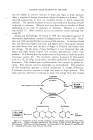
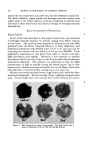
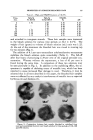
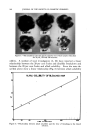
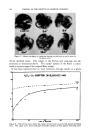
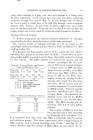
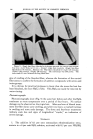
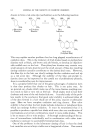
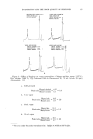
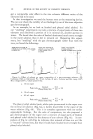
144 JOURNAL OF THE SOCIETY OF COSMFTIC CHEMISTS Figure 9.--Single hair fibers bleached in hydrogen peroxide for various time periods. Top row: (Left) Scale in 0.1 mn,. (Center) virgin hair (control) (Right) hair fiber bleached for 60 minutes. Bottom row: Hair fibers bleached for (Left) 120 minutes (Cener) 180 minutes (Right) 240 minutes. The microscope was 300 power. The scale reads 0.1 mm. between the long black lines. gree of swelling of the bleached fiber, whereas the formation of the control fiber seems to confirm the formation of addition compounds with amino and imino groups. It is obvious for practical purposes to know that the more the hair has been bleached, the more H202 is held. This H202 can easily be removed by water rinsing. Photom icro graphs Photomicrographs show (Fig. 9) the same hair before and after the H=O2 treatment at room temperature over a period of four hours. No surface damage can be observed on the virgin hair. After one hour of bleach treat- ment the fiber shows some swelling, and after two hours a marked increase in swelling and some scale damage. The three and four-hour treatments indicate scale loss and signs of longitudinal "cracks," an indication of severe damage. SUMMARY 1. The addition bf 0.1 per cent tetrasodium ethylenediamine tetra- acetate to a 6 per cent H2Ou solution, activated with 0.5 per cent NH4OH,

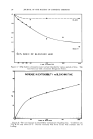
PROPERTIES OF PEROXIDE-BLEACHED HAIR 145 improves the bleach bath stability when in contact with hair by as much as 40 per cent (32.2øC., over a period of four hours). 2. The results of the use of mechanical properties for 20 per cent Index measurements in water may be misleading, if it is assumed that a relation- ship exists to the dry tensile strength of the bleached hair. 3. At 75 per cent relative humidity, hair shows increased extensibility with time in the bleaching solution. The increase is most pronounced in the first hour, 15.6 per cent in subsequent hourly treatment the increase is less, 2.9 per cent to 3.6 per cent, and becomes almost linear. 4. The mechanical properties of human hair in organic solvents indicate that alcohols of molecular weight greater than methyl alcohol are not capable of penetrating the hair, perhaps indicating a different pore size in human hair than that in wool. 5. Alkali solubility tests revealed that there may be not only a break- down of disulfide bonds, but also a partial breakdown of peptide bonds. 6. Copper-uptake determination appears to be a simple, accurate and rapid method for indicating small oxidation damage to hair fibers. 7. The hydrogen peroxide sorption increases with bleaching time and is apparently related to the degree of hair fiber swelling. The H202 uptake from a 6 per cent solution (pH 4) varies from 3.3 per cent to 3.7 per cent. The physically held H20• is easily removed by water rinsing. ztcknowledgments. The authors wish to acknowledge, with sincere gratitude and appreciation, the assistance of the entire staff of Evans Re- search and Development Corporation. We are greatly indebted to E.G. McDonough, Ph.D., whose aid and ideas, throughout the preparation of this study, have been invaluable Mr. James Haygood, whose ideas carried us through every step of our experiments and Mrs. Elsa Knitl, whose careful preparation of the graphs and photomicrographs made this entire study possible. REFERENCES (1) E16d, E., Nowotny, H., and Zahn, H., Me//iand Textif&r, 25, 313 (1942). (2) Harris, M., and Smith, A. L., •. ]Zesearch Mat. Bur. Standards, 16, 301,309 (1936) 19, 81 (1937). (3) Alexander, P., Fox, M., and Hudson, R. F., Biochem., •7., 49, 129 (1951). (4) Stoves, J. L., Trans. Faraday Soc., 38, 501 (1942). (5) Andrews, J., •. Biol. Chem., 102, 253 (1933). (6) Alexander, P., and Hudson, R. F., "Wool: It's Chemistry and Physics," New York, Reinhold Publishing Corp. (1954). (7) Speakman, J. B., Trans. Faraday $oc., 26, 61 (1930). (8) Harris, M., and Smith, A. L., •7. Research Natl. Bur. Standards 18, 623 (1938). (9) Lees, K., and Elswerth, F. F., •7. Dyers & Colourists, 68, 207 (1952). (10) Harris, M., and Smith, A. L., •. Research Natl. Bur. Standards, 17, 557 (1936). (l 1) Weber, R., SIZFFachorgan Textilveredlung, 7, 15 (1952). (12) Valko, E. I. and Barnett, G., "The Swelling of Hair in Aqueous Solutions and Mixed Sol- vents," taken from the thesis of Gabriel Barnett, submitted in partial fulfillment of the requirements for the degree of Master of Science in Chemistry, Polytechnic Institute of Brooklyn, June, 1952. (13) Alexander, P., Carter, D., and Earland, C., Biochem. •., 47, 251 (1950).
Purchased for the exclusive use of nofirst nolast (unknown)
From: SCC Media Library & Resource Center (library.scconline.org)