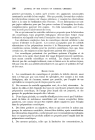
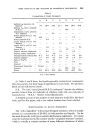
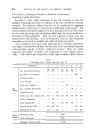
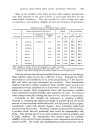
356 JOURNAL OF THE SOCIETY OF COSMETIC CHEMISTS 6. Short-chain sulphonates Sodium toluene sulphonate and sodium xylene sulphonate do not inter- fere when present at the concentration levels at which they are normally present in household detergents. 7. Stoichiometry In order to determine whether the procedure described led to titration in stoichiometric proportions, the method was tested by preparing standard solutions of pure single homologues of both anionic and cationic surface agents, and titrating each member of the first group with each member of the second. The following results were obtained: Table 4 Check on stoichiometry error Anionic DPB TPB HPB DTAB TTAB HTAB SDS .. +4-2 +4.4 +4.6 +0-5 +0.7 +1.1 +4.4 +4.3 +4.8 --0.3 --0.1 0 STS .. +4.5 +4.8 +4.3 --0.4 --0.2 --0.1 +5.1 +4.9 +4.4 +0.1 +0.1 +0.5 SHS .. +4.7 +4.7 +4.5 +1.1 +0.6 +1-0 +5.1 +4.9 +5.3 +0.6 +0.6 +0.7 SDS = sodium dodecyl sulphate STS = sodium tetradecyl sulphate SHS = sodium hexadecyl sulphate DPB = dodecyl pyridinium bromide TPB : tetradecyl pyridinium bromide HPB : hexadecyl pyridinium bromide DTAB = dodecyl trimethylammonium bromide TTAB = tetradecyl trimethylammonium bromide HTAB = hexadecyl trimethylammonium bromide Upper figures refer to experiments with chloroform as solvent. Lower figures refer to experiments with methylene chloride as solvent. It is not yet known why the two groups of quaternaries yield such different results. Considering the value of the detergent industry's annual output, it would be reasonable to expect that this technique would have been very rigorously studied and a very precise analytical method developed. This is very far from being the case, and there are many facets of the process about which little or nothing is known. Here, indeed, is a fruitful field for the research analyst.

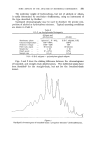
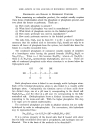
SOME ASPECTS OF THE ANALYSIS OF HOUSEHOLD DETERGENTS 357 PHOSPHATES AND BORATE IN DETERGENT POWDERS When examining an unfamiliar product, the analyst usually requires three items of information about the phosphate or phosphates present, and two about the borate or perborate. These are: (a) How much phosphate is present ? (b) What kind of phosphate was used in manufacture ? (c) What kinds of phosphate survive in the finished product ? (d) How much perborate was used in manufacture ? (e) How much perborate survives in the finished product ? The ratio P•O5: B•Oa may be from 10: 1 to 20: I mid it is therefore necessary that the method used to determine P205 should not only be to remove all traces of phosphate from the system, but should also leave the borate in a readily measurable form. The condensed phosphates of commerce consists mainly of members of a homologous series having the general formula (NaPOa)n. Na•O, or Nan+2PnO3n+ •. When n=l this becomes NaaPO• when n----2, Na•P•O7 when n=3, Na•P30•0 (pentasodium triphosphate), and so on. These are salts of condensed phosphoric acids whose structure is as shown below for triphosphoric acid. OH OH OH HO --PmO --P--O--P--OH O O O Each phosphorus atom is linked to one strongly acidic hydrogen atom. Each of the terminal phosphorus atoms is also linked to a weakly acidic hydrogen atom. Consequently the titration curves of these acids show two distinct steps, one at a pit near 4, corresponding to the diacid salt NanH•PnO3n+•, and the other at a pH near 10, corresponding to the fully neutralised salt. (Orthophosphate shows a distinct intermediate step, co- responding to the mono-acid salt. With the higher phosphates this step is so vague as to be almost undetectable.) The condensed phosphates are stable in alkaline solution but are easily hydrolysed by acids to orthophosphate. For convenience, this hydrolysis may be represented thus: Nan+•PnOa•+•q- (n-l) H•Oq-2H*--•nNaH•PO•q-2Na +. It is a curious property of the diacid salts that if treated with silver ions the fully neutralised silver salt is precipitated, and hydrogen ions are liberated. This is the basis of the methods to be described 8'9.
Purchased for the exclusive use of nofirst nolast (unknown)
From: SCC Media Library & Resource Center (library.scconline.org)