366 JOURNAL OF THE SOCIETY OF COSMETIC CHEMISTS a 3 per cent potassium iodide solution (3 g KI in 100 ml water), mix well and titrate the liberated iodine with 0.1 N sodium thiosulphate to a yellow colour. Add several drops of starch solution, or approximately 0.2 g Thyodene as indicator and complete titration with 0.1 N sodium thiosulphate. to a colourless endpoint. AXNX1.7 ø/o A = ml sodium thiosulphate used for titration N: Normality of sodium thiosulphate M = Weight of sample The colour changes noted in the above procedure are subject to variation when formulations incorporating dilute H•O,• are analyzed. H•Ox Stability Tests The preparations to be tested were subjected to H20,• stability tests at 100øC for 24 hours, and at 66øC for 7 days. The 100øC test procedure is believed to have been originated in the early 1900's by the Merck Company,. Germany. Hydrogen peroxide solutions which record 100øC stability values of at least 90 per cent usually will maintain satisfactory shelf life for a minimum of 12 months during normal room temperature storage. This corre- lation is also applicable to formulations such as emulsion and cream products incorporating dilute H =0,•. The 66øC test procedure is a modification of the above, developed for determining H,•O= stability in cream or clouded formulations. Emulsified or clouded formulations containing dilute hydrogen peroxide which record stability values of 90 per cent or above, at 66øC, generally can also be ex- pected to exhibit satisfactory shelf stability for at least 12 months, under normal room temperature storage conditions. Both tests impose extremely severe conditions to greatly accelerate the collection of data suitable for valid prediction of product stability. 100øC and 66øC HxOx Stability Test Procedures Cleanliness of the test flasks is very important. These are 50 ml volumetric flasks with fused 3" to 4" necks. Prior to usage, the flasks should be immersed for a minimum of 1 hour in 10 per cent NaOH, and rinsed thoroughly with deionized water. The flasks should then be passi- vated by immersion for a minimum of 3 hours in 10 per cent HNOa, rinsed thoroughly again with deionized water, covered loosely with aluminium foil, and dried in an oven at 110øC. After analysis for initial H•O• concentration, exactly 50 ml of the formulation under test is placed in a treated volumetric flask. The un-

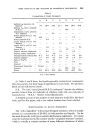
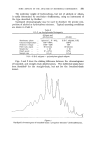
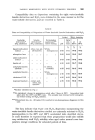
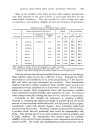
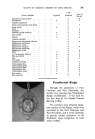
LANOLIN DERIVATIVES WITH DILUTE HYDROGEN PEROXIDE 367 stoppered flask, protected from dust, is then placed in a 100øC water bath for a period of 24 hours. The flask should be immersed so that the water level is not above the 50 ml mark on the flask, and the bottom of the flask is not resting on the bottom of the bath. After 24 hours, the flask is removed from the bath and its contents are cooled to room temperature. The volume is then readjusted to exactly 50 ml with deionized water and transferred to a beaker. If the upper sample portion is solidified in the test flask, reheat until the sample is completely fluid before attempting remove from the flask. After thorough mixing, the formulation is again analyzed for H202 concentration. Final H202 concentration Calculation ß % H202 Stability --• Initial H202 concentration X 100 The procedure for the 66 ø test is identical in all respects to the 100øC test except that the flasks are immersed in a 66øC constant temperature- water bath for 7 days. Room Temperature Samples Portions of the test formulations were also placed in 12 oz. bottles. which had been passivated in the same manner as the flasks used for elevated temperature tests, and were fitted with vented tops. These containers were maintained at 25øC (room temperature) for observation. Data on the compatibility of water-soluble lanolin derivatives with H 20 are presented in Table 1. Table 1 Data on Compatibility of Water-Soluble Lanolin Derivatives with H202 (See also Fig. Solution Appearance Initial H202 Stability H•O2 Additive Initially After 7 days Con- at at 5% Concentration at 25øC pH tent 100øC 66øC ethox. lan. alc. % % (16 tool EO) .. clear, yellow No change 4'75 6'01 99.3 99.7 ethox. lan. alc. (25 mol EO) .......... 4.80 6.05 99.5 99-9, • ethox. cholesterol (24 tool EO) .......... 4-30 6'04 96.0 99.• ethox. lanolin (75 tool EO) .. slight haze, yellow .... 5.05 6.02 99.2 99.7 compl. acer. ethox. lan. ester .. clear, colourless .... 4-35 6.04 99-3 99-6• part. acer. ethox. lan. ester .......... 6.10 6.04 96'5 97'4'. The data indicate that 6 per cent H•O,solutions, incorporating the water-soluble lanolin derivatives studied, are extremely resistant to decom-
Purchased for the exclusive use of nofirst nolast (unknown)
From: SCC Media Library & Resource Center (library.scconline.org)