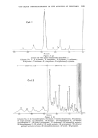
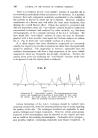
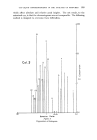
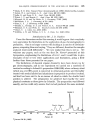
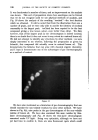
GAS-LIQUID CHROMATOGRAPHY IN THE ANALYSIS OF PERFUMES 173 THE USE OF GAS-LIQUID CHROMATOGRAPHY IN THE ANALYSIS OF PERFUMES AND FLAVOURS R. N. BEVITT, B.$c., and J. D. CHESHIRE, B.$c., A.R.I.C.* Presented at the Symposium on "Perfumery", organised by the Society, at Cheltenham, Glos., on 14th November 1962. Techniques for optimum qualitative and quantitative analysis of essential oils by gas-liquid chromatography are described. Examples of the technique applied to analysing pergumes and flayours, alone and combined in products, are given. The present scope and limitations in relating chromatograms to observed odours are discussed, and two new methods of presentation of chromatograms are suggested. INTRODUCTION GAS-LIQUID chromatography (G.L.C.) is a physical method of analysis of mixtures of volatile compounds. It is therefore particularly suited to analysis and quality control of perfume and flavour materials. A small sample of material is vaporized in a moving gas stream and carried through a porous medium supporting a liquid. Distribution of the vapour between the gas and liquid phases promotes separation of the constituents of the original sample vapour, and the individual constituents emerge from the apparatus as separate bands of vapour which may be detected and recorded as peaks on a chart. The cosmetic industry was, apparently, a little late in exploiting the technique to its full advantage. The reasons for the lag in application of the technique are twofold. Firstly, the highly competitive nature of cos- metic products minimised publication by the experts and much of the earlier publication in the field merely suggested what could be done but did not report progress. Secondly, the many rapid developments in G.L.C. technique within the petroleum industry were not applicable to essential oil analysis since the compounds present therein are much more labile than hydrocarbons. More recently, much valuable work has been reported but some published chromatograms still show poor resolution or evidence of sample decom- position, indicating that optimum operating conditions are not always being chosen. Holness • has discussed the importance of working conditions with particular reference to lavender oils. The purpose of this paper is to provide the analyst with further examples of the choice of operating parameters for perfume and flavour analyses, and to indicate the present scope and limita- tions of the technique as an aid for the perfumer. Recent reviews •-6 describe general techniques in all fields of G.L.C., while *Beecham Toiletry Division Ltd., Brentford, Middx.

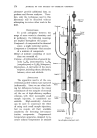
174 JOURNAL OF THE SOCIETY OF COSMETIC CHEMISTS abstracts T provide additional data on perfume and flavour analyses. There- fore, only the techniques used in this laboratory will be described without attempting to review other work in the field. DEFINITIONS To avoid ambiguity between the usage of some words in chemistry and in perfumery, the following meanings are implied throughout this paper: ½ompound--A compound in the chemical sense a single molecular species. Component or Constituent--One member of a mixture of compounds. Blend--A mixture consisting of more than one essential oil. Terpene--A hydrocarbon of general for- mula C•0H•6 (monoterpene), C•sH•4 (sesquiterpene) or C•0I-Ia• (diterpene.) Oxy-terpene--A derivative of the above terpenes, including ethers, aldehydes, ketones, esters and alcohols. APPARATUS The apparatus used is of the con- ventional packed-column type operated isothermally. Since we are often look- ing for differences between the minor constituents of two samples of essential oil, the use of high-efficiency capillary columns, with their necessarily small sample injection, is considered un- suitable. High-sensitivity detectors can be used to counteract the effect of using such small sample injections, but we require all their available sensitivity for detecting low-concen- tration components. Programmed- temperature apparatus, designed to in- crease column temperature as analysis Condenser Air In Carrier In BIO La( Stationary__ I•hase Vopour Jacket Electrically Heated Boiler B24 Figure 1 An all-glass analyser unit.
Purchased for the exclusive use of nofirst nolast (unknown)
From: SCC Media Library & Resource Center (library.scconline.org)