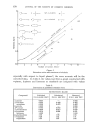
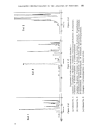
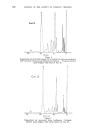
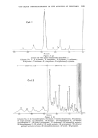
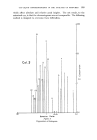
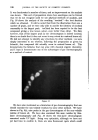
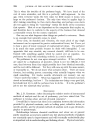
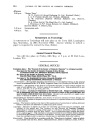
GAS-LIQUID CHROMATOGRAPHY IN THE ANALYSIS OF PERFUMES 195 Desty, D. H. (Ed.) Vapour_Phase Chromatography xii (1957) (Butterworths, London) Zubyk, W. J. and Conner, A.Z. Anal. Chem. 32 912 (1960) Suffis, R. and Dean, D.E. Anal. Chem. 34 480 (1962) Walsh, J. T. and Merritt, C. Anal. Chem. 32 1379 (1960) Klouwen, M. H. and Ter Heide, R. J. Chromatog. 7 297 (1962) McWilliam, I. G. J. Chromatog. 6 110 (1961) Ettre, L.S. J. Chromatog. 8 525 (1962) Brealey, L., Elvidge, D. A. and Proctor, K.A. Analyst 84 221 (1959) Bidmead, D. S. and Welti, D. Research London 13 295 (1960) Oliver, T. J. Chem. Soc. 2353 (1961) Griffiths, J. H. and Phillips, C. S. G. J. Chem. Soc. 3446 (1954) Introduction by Mr. J. D. Cheshire From the discussions earlier this morning it would appear that everybody now appreciates the limitations in the application of gas chromatography to perfumery. One is no longer content with looking at a number of chromato- grams, comparing them and saying, "They are different, therefore the samples analysed must smell differently". We now realise that this is not so. We welcome any papers, such as the one that Dr. Naves* presented at this Symposium, emphasizing the limitations of G.L.C. and I would like to give examples of one or two other applications and limitations, going a little further than those presented in our paper. The limitations of classical organic chemistry have been shown up by gas chromatography, and in one experiment we carried out a synthesis of isocitral according to Schmidt's preparation 1938-1939, where ordinary citral (which was over 99% pure) is converted to citral enol-acetate and thereafter treated with methyl alcohol and aluminium isopropoxide to produce isocitral. isoCitral has been said to be an isomer of citral in which the double bond position is altered. The preparation we achieved had exactly the same physical constants as those given by Schmidt. The preparation was followed exactly, and we could only assume that we had produced the same material. *Journal 14 29 (1963) Citr•l • C• 5b Minutes Figure 10 Isocttral ? •6 •6 •b ,o

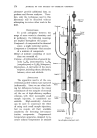
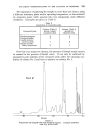
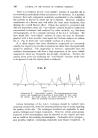
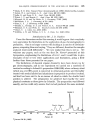
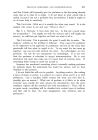
196 JOURNAL OF THE SOCIETY OF COSMETIC CHEMISTS It was fractionated a number of times, and no improvement on the analysis was shown. This sort of preparation shows how azeotropes can be formed that we do not recognise until we use physical methods of analysis, and Fig. 10 shows the analysis of the resulting "isocitral"--the best fraction which we obtained. It will be noted that from the illustration there are a number of peaks, and we were only able to ascribe the identity of isocitral reasonably to the largest peak. isoCitral has been reputed to be the best compound giving a true lemon odour, even better than citral. We find, however, that if this largest peak in our chromatogram is indeed isocitral, there is no doubt that it does not occur to any extent in a natural lemon oil. We did not attempt to identify any structures by other methods: we were simply interested to see whether, following the preparation as given by Schmidt, this compound did actually occur in natural lemon oil. This demonstrates the fallacies that can arise with classical organic chemistry, and I hope it demonstrates one of the advantages of gas chromatography as a method of control. , Figure 11 We have also mentioned as a limitation of gas chromatography that one should examine the non-volatile residues by some other method. We have shown in Fig. 8(c), nine peaks in the gas chromatogram of the non-volatile residue of lemon oil. We have also examined this same residue by thin- layer chromatography and Fig. 11 shows the thin-layer chromatogram examined under UV light. Being very optimistic, although we have not yet had time to confirm it, there are nine fluorescent spots which could
Purchased for the exclusive use of nofirst nolast (unknown)
From: SCC Media Library & Resource Center (library.scconline.org)