GAS-LIQUID CHROMATOGRAPHY IN THE ANALYSIS OF PERFUMES 191 achieved by G.L.C., although the corresponding nonenes have recently been separated •9. It should be possible to extend the method to oxy-terpenes, thus obtaining four peaks for citral and two each from geraniol and nerol. Flavour The effect that odourless, non-volatile components may have on the basic taste contribution of a flavour mixture has already been mentioned. When analysing flavours, therefore, it is especially important that the G.L.C. technique should be supplemented by other analytical methods. The fore- going remarks on isomerism and odour may be equally applicable to taste. Isomers of similar odour may contribute different taste sensations to a flavour, e.g. one isomer may be more bitter than another. G.L.C. can be used to control such variations once they have been recognised. Vapour Detectors Most users of G.L.C. today take advantage of the high sensitivity to organic yapours of the various types of ionisation detectors. The response of these detectors is proportional to the concentration of the vapour and to some function of its molecular structure. No detector is known at present which responds in proportion to the "specific odour" of a compound. Such a detector would yield a chromatogram in which, subject to the limitations described in the section entitled Correlation, the largest peaks corresponded to the compounds contributing most to the odour of the sample. The nearest approach to such a detector at present is the perfumer's nose. A preliminary analysis made with a flame-ionisation detector may be imme- diately followed by a repeat in which a heated capillary-tube, with a perfumer attached to the exit end, replaces the detector. The perfumer observes the smell at the appropriate moment in time. (The capillary is heated to avoid condensation and consequent odour tailing.) Identification or classification of peaks is aided by the observed odours, but they cannot be used to assess the odour of the complete essential oil since so little is known at present about the additive properties of odours. Although it has been suggested that the nose is more sensitive than the best detectors towards some organic yapours, only the major constituents of a mixture can be detected by smelling the yapours eluting from the G.L.C. column. This is because the vapour has been diluted many times by air before reaching the nose. The smelling method of detection is valuable for indicating whether a particular constituent is likely to improve or degrade the odour of the complete oil, without necessarily identifying the compound.

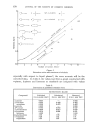
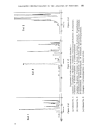
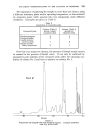
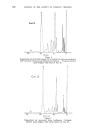
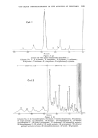
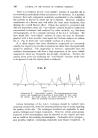
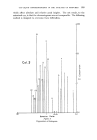
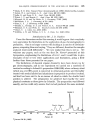
192 JOURNAL OF THE SOCIETY OF COSMETIC CHEMISTS Modem theories of the sense of smell indicate that a detector based on adsorption might be desirable, the closest approach to this being the surface potential detector used by Griffiths and Phillips TM. Unfortunately, this detector is non-reversible with respect to adsorbed yapours, and its sensitivity is many orders less than ionisation methods. PRESENTATION OF DATA The gas-liquid chromatographer frequently finds difficulty in expressing his interpretation of chromatograms in laboratory reports. Tabular presentation of tediously and, sometimes, unnecessarily calculated concentra- tions of each component does not give the "at-a-glance" comparison which can be made between two chromatograms. To follow a discussion of inter- pretations, the reader needs a graphical representation of the chromatograms before him. Since the conditions for analysis of essential oils usually fall into three categories (Table 1), it is possible to duplicate copies of chromatograms of various standard oils analysed under the appropriate column conditions. To each member of the staff who may be interested in G.L.C. reports, is circulated a loose-leaf folder or "Chromatogram Atlas" containing-- (a) One copy of each chromatogram of standard oils which are frequently being analysed. Each chromatogram bears the number of the column on which the analysis was made and each peak is numbered (whether or not it has been identified). (b) A key defining the conditions appropriate to each column number. (c) A key for each chromatogram, giving the identities of peaks as known up to date. The report writer needs only to refer to the column number and type of oil before commencing his discussion of observations made on similar oils. Peaks may be referred to by number or by name according to convenience, but it is not necessary to circulate a detailed table or a complete chromato- gram with each report. Only the points of difference need be discussed about each analysis. With the chromatogram at hand, the reader can see the relative significance of the reported differences. An alternative method of presentation designed to enable direct com- parisons between chromatograms of similar oils, analysed at various times, would be of value for following seasonal changes in the essential oil industry. Owing to the inevitable ageing of liquid phases, chromatograms run weeks or months apart are not directly comparable by superimposition. The ageing process not only causes slight differences in retention ratios, and larger differences in absolute retention times, but also leads to changes in efficiency
Purchased for the exclusive use of nofirst nolast (unknown)
From: SCC Media Library & Resource Center (library.scconline.org)