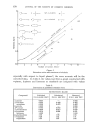
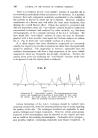
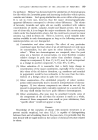
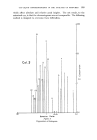
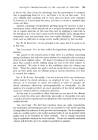
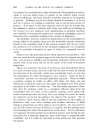
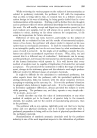
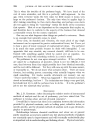
GAS-LIQUID CHROMATOGRAPHY IN THE ANALYSIS OF PERFUMES 177 Retention ratios observed by measurement of chromatograms may be used to determine the identity of peaks by comparison with data obtained by the following procedures: Calibration with available compounds Compounds believed to occur in the sample undergoing analysis should have their retention ratios determined relative to the chosen standard for each column, by chromatographing each compound mixed with the standard. The purity of the compound used for qualitative calibration is not critical. This method is mainly of value for the more obvious compounds, e.g. menthol, menthone, menthyl acetate in peppermint oil. It does, however, pre-suppose some knowledge of the composition of the sample and many peaks will still remain unidentified. Interpolation and extrapolation of homologous series Logarithms of retention ratios of members of homologous series may be plotted against the number of carbon atoms in the molecule. Interpolation and extrapolation of the graph provides data for unavailable members of the series. For flavours and perfumes containing aliphatic aldehydes, ketones, esters and alcohols, this method is valuable. It is, however, of little use for identification of unknown terpenes or oxy-terpenes since homologues do not normally occur, and at least three compounds are needed to prove the existence of a series. Extrapolation of homologous series may be extended to isomeric forms if sufficient reference compounds are available. Fig. $ shows the application of this method to low molecular-weight aliphatic alcohols. Once the n-primary series has been plotted, other series may be drawn as parallel lines through one or more reference points. Conversion of published data There are, at present, no British Standard liquid phases. In spite of recommendations •ø, analysts still prefer to use their own "ideal" liquid phases, with the result that retention ratio data are often published for analyses on columns other than those available. An empirical correction can be applied, however, within groups of compounds, e.g. monoterpenes. The published retention ratios are plotted against the corresponding values observed for as many compounds in the group as are available. Retention ratios for other compounds can then be read from the published data via the straight-line graph. It is convenient to use log/log graph paper, and the closer the experimental conditions used approach to those published,

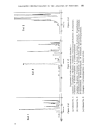
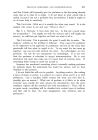
178 JOURNAL OF THE SOCIETY OF COSMETIC CHEMISTS 2 ] oH tert-n-alcohols R_ i 4 )---.--i--oH •ec.-n-alcohols [ ß 3 s Z-) .... o. s ..... i I ß e/• --*-- '--OH O.I ,,ø7 .,.I t I 2 3 4 5 6 7 8 9 I0 Number of Carbon Atoms" Figure $ Retention ratios and structures of alcohols o•0 especially with respect to liquid phases •4, the more accurate will be the converted data. In Table 2, the values read from a graph constructed with a-pinene, •-pinene and limonene as standards are compared with values Table 2 Conversion of published retention data RETENTION RATIO Compound Published Calculated Observed P.E.G.4,000 130øC P.E.G. 400 78øC P.E.G. 400 78øC 0½-pinene 0.437 -- 0,352 0½-fenchene 0.532 0.448 0.4½2 camphene 0-559 0,472 0.4½2 [•-pinene 0.½90 -- 0,588 Aa-carene 0,795 0.743 0-737 0½-phellandrene 0.856 0.810 0'837 0½-terpinene 0.914 0.884 0,901 limonene 1,000 -- 1'000 [3-phellandrene 1.08 1.08 1.08 T-terpinene 1,26 1.31 1.31 terpinolene 1-53 1.67 1.64
Purchased for the exclusive use of nofirst nolast (unknown)
From: SCC Media Library & Resource Center (library.scconline.org)