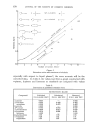
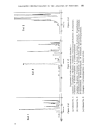
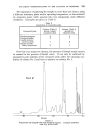
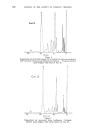
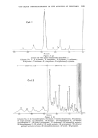
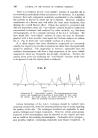
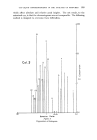
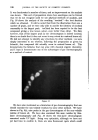
GAS-LIQUID CHROMATOGRAPHY IN THE ANALYSIS OF PERFUMES 1•)•) in lemon oil), then it has the advantage that the presentation is compact. One is progressing from 0.1 to 1, and from 1 to 10, on this scale. It is very unlikely that anything will be more than ten times your standard. If, however, it is more than ten times, you have to choose a standard that comes out later. Another advantage of logarithmic plotting along the abscissa is that a homologous series, which spreads out on a normal chromatogram, will come out at regular intervals on this base line, and by applying a scale rule to the histogram it is very easy to pick out the homologous series, though these compounds may not previously have been easily identified. Homologous series such as aldehydes in orange oil are readily plotted by this method. DR. M. H. KLOUWEN : So the principle is the same, but it is easier to do in this way. THE LECTURER: Yes, we have added the logarithmic plotting along the abscissa. The answer to the second query is that there is a problem concerning ageing of columns, but with this representation we constantly relate retention ratios to their original values. We know by looking at the whole chromato- gram that a peak is slowly shifting along one way or the other relative to our standard. We refer it back to the conditions when the column was fresh. When the column has aged to such an extent that you can no longer pick up these peaks that are drifting along in various directions, it is time to re-pack the column. DR. Y.-R. NAVES: Personally, I am not in favour of the use of detectors which destroy the eluted substance as employed by you. To use such a detector, it is necessary to repeat the analysis in order to examine the eluted substances olfactively, spectrographically or chemically. In the analysis of a complex product, an exact separation of the eluted substances cannot be assured without continuous detection. In this case, it is possible to effect detection on one part of the effluent and to study the other part olfactively, physically or chemically, but such a solution involves experimental complications when executed on the normal analytical scale. THE LECTURER: We find that retention times are quite reproducible for consecutive chromatograms and we can therefore be sure which material is being eluted by reference to the previous chromatogram. On the analytical scale one usually needs to run a pilot analysis before it can be decided which peaks need to be identified by other methods. One is usually interested only in qualitative analysis by such methods. Choice of a suitable analytical column will therefore give the simplest quantitative analysis.

200 JOURNAL OF THE SOCIETY OF COSMETIC CHEMISTS We use flame-ionization detectors because our apparatus was converted from thermo-couple detectors. These are of all-glass construction and simple maintenance is another factor. We also consider the safety in hand- ling radioactive sources by relatively unskilled operators. Finally, the flame-ionization detector is insensitive to water. It is a fact that the argon detector depresses the sensitivity of peaks which are eluted with, or after, water. DR. M. H. KLOUWEN: This detection method is effective, particularly if the peaks are perfectly separated. If they are not, then difficulties arise. THE LECTURER: This is quite true, but we would not consider there would be much value in isolating peaks which were not completely separated. DR. Y.-R. NAVES: In my opinion, the analysis of complex products such as essential oils and natural perfumes lends itself to the use of temperature programmed G.L.C. and also pre-columns, the latter to compensate for the influence of certain alterations. I would be particularly pleased to learn your views on this subject. THE LECTURER: We believe that temperature-programmed gas chromato- graphy is an excellent thing in theory, but we would like to examine the economics. A complicated ancillary heating apparatus is necessary to ensure reproducible heating, and there is need for a cooling period between each analysis. The latter can be balanced by analysis on two or three isothermal columns while one is waiting for the programmed-temperature column to cool down. We feel the main point is the difficulty of obtaining published retention data that can be applied to observations on temperature-programmed columns. This means that there is a limitation of calibrations to the com- pounds that one has available in one's own laboratory. DR. Y.-R. NAVES: The use of temperature programmed G.L.C. necessi- tates particularly the consideration of the injection temperature. It is necessary either to achieve a certain over-heating of the injector, which is not very convenient, particularly on account of the sensitiveness of sub- stances which are amongst the most volatile, or to arrange direct injection into the column charge, which raises other problems. Do you have any experience of the best solution to these difficulties ? THE LECTURER: We have not studied this point in detail, but we have not noticed any decomposition of such labile compounds as linalol or linalyl esters when using a stainless steel vaporizer on our preparative-scale column (Atkinson and Tuey in "Gas Chromatography 1958", Ed. D. H. Desty,
Purchased for the exclusive use of nofirst nolast (unknown)
From: SCC Media Library & Resource Center (library.scconline.org)