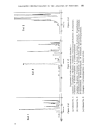
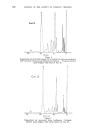
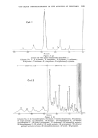
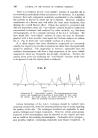
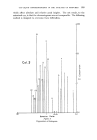
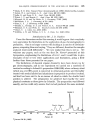
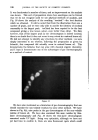
GAS-LIQUID CHROMATOGRAPHY IN THE ANALYSIS OF PERFUMES 197 correspond to the nine peaks on our gas chromatogram Fig. 8(c). This is the sort of auxiliary work that is required to strengthen conclusions drawn from gas chromatography. There has been some recent work, by Brown and Shyluk [A hal. Chem. 34 1058 (1962)•, on gas chromatography of coumarin derivatives. The main point is that in a lemon oil, coumarins could be responsible for deterioration or ageing effects. They may have no effect on the smell but they could affect the stability of the oil. One must not overlook, therefore, the non-volatile compounds. Even if they do not actually con- tribute to the oil when fresh, they may affect the stability of the oil in storage, or when it is stored in a product. A final application that we have described, where gas chromatography is applied directly to perfumery, is the smelling of peaks as they come out of the column. We have shown that if a peak in one of our chromatograms is nearly full scale one can smell most of these compounds coming out of the column. However, there is no doubt that when one is analysing only about a milligram of sample one cannot smell all the peaks that show on the chromatogram one can only smell those that are present in major concentration. We run a pilot chromatogram to determine the times at which the various peaks are coming out. We then do a repeat analysis and attempt to smell the peaks we are interested in. We replace the detector by a capillary tube and the perfumer stands at the capillary tube smelling the peaks at the appropriate moments. This can be quite a new problem to the perfumer, who has very little time in which to make up his mind as to what he is smelling. •)ISCUSSION DR. M. H. KLOUWEN: Up to this moment the question whether there is a difference in odour of optical antipodes or not, has not been satisfactorily answered. In the past, a number of research workers have tried to prepare optical isomers ooe highest purity with little success. From the publications of high scientific standing--rare as they are in this field--I have not been able to ascertain whether the odour of optical antipodes really differs. There are two references IRupe, H., and Wiederkehr, F., Helv. Chim. Acta ? 669 (1924) Johnston, R. G., and Read, J., J. chem. Soc. 236 (1934)1 stating that there really is a difference but the dates are 1924 and 1934 and we dare say that at that time traces of impurities, easily found today, could not be found at all. In the literature we also find a number of references claiming that the odour intensity of enanthiomers is different. Naves I'S.C.I. Monograph No. 1 (Staples Printers Ltd., London), 38 (1957)• has presented an excellent review on the subiect.

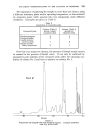
198 JOURNAL OF THE SOCIETY OF COSMETIC CHEMISTS As a result of your highly appreciated olfactive research concerning the enanthiomers d- and /-carvone you conclude that the odour intensity of d-carvone is stronger than that of/-carvone, but that the odour character of both is identical. From the facts mentioned above, the conclusion should be that optical antipodes can show a difference in odour intensity but that the apparent difference in odour character has never been proved. This conclusion is in accordance with similar effects noted in the biological and pharmaceutical fields, e.g. the action of/-adrenaline on blood pressure is fifteen times stronger than that of the d-modification. Perhaps this phenomenon could be explained if optical activity could be proved to be present in the receptor system. How you measure odour intensity ? Was it done by determining the respective minimum stimuli or was your experiment carried out at higher concentrations ? THE LECTURER: The experiments we carried out were, unfortunately, carried out about four years ago. Being a digression from our normal course of work at that time we did not pursue this line and we did not attempt to refine our simple odour tests further than already reported. The answer to your question is, therefore, that an equal quantity of each isomer, 5 mg, was chromatographed and condensed in a capillary tube at the outlet of the column. The capillaries were carefully drained on to small watch-glasses and kept covered by a second watch-glass, except while odour observations were made by four people, including one perfumer. You will realise that the observations were not statistically sound. The observations were carried out at high concentration not at minimum odour concentrations. We felt that this work would possibly be of interest to a number of people and this is why we reported it, but we have not pursued it any further ourselves. DR. M. H. KLOUWEN : The "histogram" you describe has already been proposed by Tesseire [Recherches 9 10 (1959)] in relation to oil of Clary Sage. Do you not suppose that ageing of the column would have an influence on the reproducibility of the histogram ? THE LECTURER: The work published by Teisseire, it is true, does give a concentration ordinate, which is a logarithmic scale. This might be as 0.1, 1, 10 and 100%. He also gives a line representing peak concentration, the concentration of each component being determined from the chromato- gram. He does not, however, use the logarithmic scale on the abscissa. We do because if you have a value of 1'0 for the standard reference compound that has been chosen (preferably something occurring in the samples you are commonly analysing, e.g. menthol in peppermint or one of the citrals
Purchased for the exclusive use of nofirst nolast (unknown)
From: SCC Media Library & Resource Center (library.scconline.org)