GAS-LIQUID CHROMATOGRAPHY IN THE ANALYSIS OF PERFUMES 201 Butterworths, London, 1958, p. 279) operating at approximately 150øC above the 130 ø column. Partial decomposition may be recognised fairly readily if the whole column effluent is collected, re-analysed and compared with the analysis of the starting material. DR. Y.-R. NAves: I would like to insist on the consideration of economic factors. The practice of chromatography must not be restricted to experts. It is better to establish simple rules and procedures which are easily carried out, so that a trained operator, using a single instrument, can examine a minimum of 20 to 22 different products in the course of one working day. Standardisation of chromatographic practice in our industry is desirable and this must not disregard economic considerations. TH• L•½TUR•R: G.L.C. applied to routine essential oil analysis is a very reasonable suggestion but an expert must be available for the interpretation of results, and particularly for detecting faults such as ageing of liquid phase, decomposition of sample, etc. Even when using a simplified technique, it would be optimistic to hope to analyse 20 to 22 samples in one day on a single apparatus. This would assume that each analysis takes only 20 minutes, no maintenance of the apparatus is necessary and no calculations are made beyond measurement of a few selected peaks. We believe that 10 to 12 analyses per day would be a more realistic figure for routine analysis. MR. B. H. KINGSTON: You mentioned that the separation of a- and E- isomers of several terpene derivatives has not yet been achieved by G.L.C. In fact, for several years our research department has successfully resolved mixtures of a and •-citronellol (obtained by a synthetic route) using diglycerol at 180øC in ordinary packed columns. Incidentally, our own evidence, based on infra-red and other measure- ments, suggests that the rose alcohols and related compounds exist only in the E-form--at least in nature. DR. Y.-R. NAVES: I would like to draw attention to an error made in your paper. You state "The ability to separate the isopropylene and iso- propylidene (a and •) isomers of several terpene derivatives has not yet been achieved by G.L.C." In fact, such separations (a and • citronellols, a and/• linalols) were described in 1958 by me and Aldo Odermatt CBull. Soc. Chim. France, 382 (1958)!, and have been developed further since that time. TK• L•½TUR•R: I would like to apologise for my oversight. We have again looked at your paper with great interest, and we have been examining the relative retention times of the a and • fractions. There have been various publications. I would like to present a few ratios to you. Dr. Naves

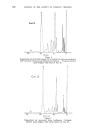
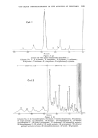
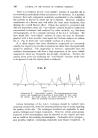
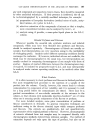
202 JOURNAL OF THE SOCIETY OF COSMETIC CHEMISTS has done his analysis on a Perkin-Elmer "C" column which I believe is silicone oil, a non-polar column, and for citronellol he gets a ratio of a to fi forms of 1 to 1.11. In each case the a form would be 1. Linalol isomers differ by 1 to 1.19. Other work in this field has shown ratios of the order of 1 to 1-14 for non-polar columns. We have examined linalol in which we did get the suggestion of two peaks from benzyldiphenyl which can be treated as a fairly non-polar column, and we get a ratio of 1 to 1.11. It is to be expected that isomerization--the movement of the double bond--will have a different effect on columns of different polarity. However, it is rather surprising to find that this similar type of a-, fi-isomerization on the same liquid phase gives such different ratios for the citronellol and the lina!ol. The only difference between them is the shift of the double bond. Have you any suggestion why this may be so, or was I incorrect in measuring the retention ratios given in your paper ? DR. Y.-R. NAVES: Are these the relative retention times, or the relative proportions ? THE LECTURER: The relative retention times, a to fl. DR. Y.-R. NAVES: I would not expect from any theoretical consideration that the two must be of the same order.
Purchased for the exclusive use of nofirst nolast (unknown)
From: SCC Media Library & Resource Center (library.scconline.org)