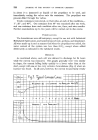
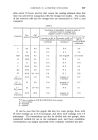
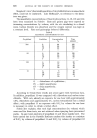
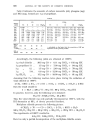
PHYSIOLOGICAL PROPERTIES OF PROPELLANTS 349 The partial decomposition of the propellants is a function of the test inethods described below. Repeated contact with the heated surfaces will continue the degradation of the propellant-air mixture. With trichlorofluoromethane (propellant 11): 3 CFCla -{- 4 H20 • CO -{- COC12 -{- CO,• -{- Ci• -1- 3 HF -1- 5 HC1 412 g propellant 11 28 CO -{- 99 COCla -1- 60 g HF -1- 182.5 g HC1. In practice: 0.43 g CO 2.88 g COCla 39 g HC1. Related to the contents of acid halide, only 25% of the propellant is decomposed, and with methylene chloride only 21.4%. Supposing that 100 g of each gas is decomposed by a hot flame at 1000øC in a room having a capacity of 50m a, then the ppm value is as follows: For vinyl chloride .. 63.2 CO 0.05 COC12 126 ppm HC1 ,, propellant 11 .. 2.4 ,, 3.10 ,, ß 98 .... ß . ß .... 12 .. 2.4 ,, , 1 10 ,, , 62 .... ß .... 114 .. 1.3 ,, , 5.40 ,, , 34 .... thyl ß ß ,, me ene chloride.. 24.4 ,, , 8.10 ,, , 100 .... The 3/IAC value for carbon monoxide, which is near 100 ppm, has not been reached in any instance. On the other hand, the MAC value of phosgene, near 1 ppm, is exceeded by all gases with the exception of vinyl chloride. The MAC value for HC1 is near 5. The quantities of HC1 obtained with all propellants are considerably in excess of that value despite the fact that the HF formed with propellants 11, 12 and 114 had been ignored. The irritation threshold for HC1 is in the region of 35 ppm for brief inhalation, that for HF even lower, and is obtained in every case. This confirms the findings of ReedL The concentrations of halogen acids formed are significantly greater than those of phosgene. They have such an irritating effect on the respiratory organs, that an individual cannot remain in this atmosphere for a long period. Although the halogen acids are an excellent warning, the danger of phosgene formation in a conflagration should, however, not be underestimated, because as little as 35 ppm have a lethal effect during a lengthy inhalation period. The halogenated hydrocarbons liberated after application of a pressurized spray cannot decompose into toxic gases, not even by decomposition in a flame of 1000øC. As a result a fatality reported in 1958 cannot be attributed to the use of an aerosol insecticide •ø. R. C. Downing 2 has published a list of decomposition products obtained from propellants 11 and 12. Without defining the temperature he refers to warmed or heated surfaces, but no details of the experimental procedure are given. For the tests described above an exact amount of propellant was sprayed into a glass tube, through which an air current of 3.5-4 l/rain

350 JOURNAL OF THE SOCIETY OF COSMETIC CHEMISTS was sucked, and into which a hot plate or a gas flame was placed. The temperatures were measured electrically. Carbon monoxide was deter- mined by means of the Auer apparatus, phosgene by measuring the absorp- tion of 1.3-diphenyl urea in UV, and HC1 by collection in 0.1N NaOH, neutralisation with H2S04, and titration with 0.1N AgNOa solution. The experimental errors were 4- 5%. It was proven that the normal application of pressure packs, even in the event of decomposition of the propellants on hot or red-hot surfaces, cannot be injurious to health. In all instances, the consider- able quantities of halogen acids developed will be a warning and the irritating effects will cause a person to leave or to ventilate the room immediately. •KIN IRRITATION It is necessary to distinguish between super-cooling of the skin by evaporation, which applies to all types of propellants, and definite skin compatibility. Spraying of an aerosol with a high propellant content from too short a distance on to the human skin may cause skin irritation, redden- ing or even blister formation. The possibility is the greater the lower the boiling point, and the more sensitive the skin is. We all know of the occasional consumer complaints that the pressurized product has a caustic effect. In actual fact, the directions for use have not been followed. Such cases are relatively unusual and it has never been reported that normal healing of the skin has not taken place after blister formation. Information concerning the compatibility of fluorinated hydrocarbons with the skin has been published by Quevaville et al n with the following conclusions: The treatment of the skin of rats, three times a day for two months, with pro- pellants 11, 12 and 13 caused neither macroscopic nor microscopic changes. The good compatibility of sesame oil and propellants 11, 12, 113 and 114 with the skin of rabbits, and with the mucous membrane of rabbits' eyes, was established by Scholz 9. A number of cosmetic preparations containing vinyl chloride as well as propellants 11 and 12 have been tested for compatibility with the skin. An oily suntan pack did not cause any skin reaction TM with 600 separate tests on 50 patients including some suffering from eczema. A similar test has been carried out with a hairspray •a. The hair and skin of the head tolerated the product even after over-dosages and no differences could be detected between the various propellants. Only a con- centration in excess of 20% methylene chloride caused structural damages of the hair, especially where subvisible changes of the hair have akeady occurred. Tests with body deodorants •4, footsprays containing vinyl chloride •5, foam products containing propellant 12 •6 proved likewise positive.
Purchased for the exclusive use of nofirst nolast (unknown)
From: SCC Media Library & Resource Center (library.scconline.org)