460 JOURNAL OF THE SOCIETY OF COSMETIC CHEMISTS tography with this solvent, a beaker containing 30 mi. of 0.3% ammonia is placed into the chamber. The second solvent is prepared as follows: To 55 parts of 2,6-1utidine are added 20 parts of isopropanol and 25 parts of water. To each 500 mi. of this mixture is added 3.3 mi. of diethylamine. During chromatography with this solvent a beaker containing 100 mg. of sodium cyanide in 4-6 mi. of water is placed into the chamber. EXPERIMENTAL Various hair swatches were exposed to the following treatments for comparative study: A--untreated hair. B--hair subjected to three minutes of total immersion in a reducing solu- tion of pH = 9.3 (alkali = 0.67 N thioglycolate = 6.62%). C--hair subjected to treatment B followed by a four-minute total immer- sion in 1.5% H202 at pH = 4.8. D--hair subjected to 8 minutes of total immersion in solution of B fol- lowed by a four-minute total immersion in 1.5% H20=at pH = 4.8. The hair swatches in all cases above were given final water rinses in order to remove residual matter and then were dried with a hair dryer. Two hundred rag. hair charges were placed in 5 mi. of 1:1 HCl in Pyrex test tubes. The tubes were sealed, and the hair was hydrolyzed in a para- fIin oven for 6 hours at 120øC. At the end of the hydrolysis, the tubes were allowed to cool, then cracked open. HCl removal was accomplished by re- peated evaporation in a vacuum oven. The hydrolysates were then filtered and made up to 5 mi. with deionized water. The filtered hydrolysates were separated into their acidic, basic and neutral fractions by means of ion exchange columns. The hydrolysate was first passed through a column of Amberlite IR-4B©* the acidic amino acids are adsorbed, and the neutral and basic amino acids pass through. The adsorbed acidic amino acids were eluted with N/10 HC1 and collected separately. (The column is conveniently regenerated with 4% NaOH.) The basic and neutral hydrolysate fraction was then passed through a column of Amberlite IR-50-C which was previously buffered at pH 4.0 with an acetate buffer. The basic amino acids are adsorbed, and the neutral amino acids pass through. The basic amino acids were eluted with N/10 HCl. (The column is regenerated with 4% NaOH and buffered at pH 4.0 with acetate buffer.) By buffering the Amberlite IR-50-C at pH 4.0, cystine appears in the neutral fraction of amino acids. That cystine * Amberlite is a trade name of Rohm & Haas Co., Philadelphia, Pa.

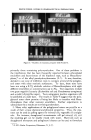
METHOD FOR SEPARATION OF AMINO ACIDS IN HAIR 461 was found exclusively in the neutral fraction was demonstrated by the platinic iodide test (2).* The solution (6 to 12 ml.), corresponding to 200-400 mg. of protein hy- drolysate, was placed near a corner of the filter paper sheet, 6 cm. from either edge. The paper was held with one edge slightly overlapping the opening of the trough and pressed into it with a strip of sheet glass some- what longer than the paper. This assembly was then transferred to the chamber which had been prepared as follows: A removable lead tray, the bottom of which was covered with a two- phase layer of water and the first solvent, was placed on the floor of the box in order to secure a saturated atmosphere. The chromatogram was allowed to develop for 24 to 72 hours. The paper was dried in a drying cupboard, turned through a right-angle and returned to the trough in order to be de- veloped by the second solvent. After drying, the paper was sprayed with 0.1% ninhydrin in n-butanol, again dried, and then heated at 80 ø for 5 minutes. The spots were outlined with pencil because of eventual fading. RESULTS A--Untreated Hair. It was shown that all the amino acids expected to be present in untreated hair could be accounted for. There were twelve spots on the chromatogram for the neutral fraction, two spots on the chromatogram for the acidic fraction, and four spots on the chromatogram for the basic fraction. The spots for methionine, leucine, phenylalanine and proline in the neutral fraction were so close together that they could be regarded as one spot. No special effort was made to separate the in- dividual members making up this spot. The amino acid composition of each fraction is considered to be as follows: •lcidic Rs Aspartic acid 0.14 Glutamic acid 0.24 Basic Lysine 0.50 Histidine 0.72 Hydroxylysine 0.76 Arginine 0.67 Neutral Glycine 0.40 Alanine 0.57 * Another--less conclusive--proof of the presence of cystine in the neutral fraction is the formation of typical cystine crystals when the neutral fraction ofuntreated hair was permitted to remain over a weekend at refrigerator temperature. This crystalline precipitate must be cystine because it is the only amino acid in this fraction which exhibits such high insolubility.
Purchased for the exclusive use of nofirst nolast (unknown)
From: SCC Media Library & Resource Center (library.scconline.org)