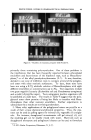
462 JOURNAL OF THE SOCIETY OF COSMETIC CHEMISTS Serine 0.33 Proline 0.87 Valine 0.78 Threonine 0.50 Leucine 0.84 Methionine 0.82 Phenylalamine 0.86 Tyrosine 0.59 Tryptophan--theoretical 0.76 Cystine 0.13 The acidic fraction contained a ninhydrin spot at the solvent "frontal." This was considered to be due to inorganic salt impurities collected during the ion exchange separation. The spot was not characteristic of a typical amino acid and was, therefore, discounted. B--Hair Treated Three Minutes in Reducing Solution. Ninhydrin de- velopment of the chromatograms of the three amino acid fractions of treated hair disclosed that a marked change had taken place: The acidic fraction was completely void of amino acids. However, two new spots appeared in the neutral fraction, and it is possible that they are due to the presence of some degradation product of the native acidic amino acids. The basic fraction, however, was completely accounted for. This finding was so unexpected that replication of this series of experiments was neces- sary to exclude the possibility of experimental error. The results of the second experimental series were identical with the first one and suggest that the acidic amino acids were altered during the reducing treatment. It is believed that this change may be a result of deamination by the re- ducing solution to produce oxaloacetic acid from the aspattic acid: --CO-•CH-- CH•--COO- -------• HOOC- CH2--CO--COOH I - -NH and a-keto glutaric acid from glutamic acid: ---CO•CH--CH•--CH•- CO()- -- .... HOOC--CH,,.---CH2- CO---COOH - NH C & D--Hair Reduced by Method "B" for Four and Light Minutes Re- spectively Then Oxidized in 1.5% H202 at pH ¾.8. Both methods of treat- ment (C & D) yielded identical chromatograms. The chromatograms of the acidic fractions for both of these treatments had a new spot which was not encountered in untreated hair. For reasons not clearly understood, the spots for glutamic and aspattic acids reappeared in the hydrolysates from reduced-and-oxidized hair. The basic fractions of both treatments revealed chromatograms which could account for all amino acids. The neutral fractions of both treatments contained two new spots which were not encountered before. A spot at an Rf value of 0.10 appears to match

METHOD FOR SEPARATION OI AMINO ACIDS IN HAIR 463 the position of a known chromatogram of lanthionine. In addition, there appeared a very large spot or grouping of spots at an Rf value of 0.50. Since these new spots appeared only as a result of treatments C & D, it is assumed that their presence is the result of some changes which took place during reduction and oxidation of the hair. These changes probably oc- curred at the disulfide linkage since lanthionine was produced other changes probably occurred at the polar linkage as well since the new spots are some modification of the acidic areinc acids. DISCUSSION AND CONCLUSION In all treated hair swatches there seemed to be a distinct reduction of the total quantity of aspattic and glutamic acids. The appearance of a new spot in the neutral fraction as a result of a typical cold wave procedure (total immersion notwithstanding) suggests formation of lanthionine. It is known that acid hydrolysis of proteins destroys only tryptophan by polymerizing its residue with a prosthetic carbohydrate to form humin. On the other hand, it is known that alkaline hydrolysis of proteins destroys cystine and hydroxy amino acids, converts arginine to ornithine, causes loss of ammonia, and rapidly racemizes all the areinc acids. It is likely, therefore, that the changes in areinc acid composition of hair keratin re- ported here take place not during hydrolysis but during (alkaline) cold wave treatment. It is proposed that, during cold waving, the reducing solution not only converts disulfide linkages to sulfhydryl groups, but also causes a variety of reactions due to its high alkalinity. Thus, the conversion of cystine (to lanthionine) and deamination of acidic areinc acids (glutamic and aspattic acids) and of basic areinc acids (arginine and lysine) might well account for the unusual findings reported here. Evidently these reactions are not quantitative, and considerably more work will be required to elucidate completely the chemistry of the interaction between keratin and cold waving preparations. (Received February 7, 1964) REFERENOES (1) R. Consden, A. H. Gordon, and A. J.P. Martin, Biochem. St., 38, 224 (1944). (2) J. W. Sease, et aL, dnaL Chem., 20, 431 (1948).
Purchased for the exclusive use of nofirst nolast (unknown)
From: SCC Media Library & Resource Center (library.scconline.org)