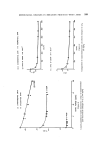
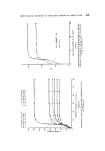
RHEOLOGICAL CHANGES IN EMULSION PRODUCTS WHEN AGED 605 have been based upon this- are latex emulsions where the stabilizer is of a rather different type and 'limited coalescence' is reported. There is a small change during the first 24-48 hr, and after that very little further change. I suspect that this might also be due to the fact that the rate of disappearance of very small particles has not been studied in detail nor appreciated. MR. H. E. GHRR•TT: Mr. Stephens's second question was settled by G. S. Hartley in the late 1950's. In the micelles containing oils in solution you have a low vapour pressure of a solute. In an emulsion the vapour pressure of the solute, the larger particle sizes, is equal to the normal vapour pressure, but as the particle size of the emulsion decreases one gets an increased vapour pressure or solution pressure, as the case may be. Before you get down to the micelie region the vapour pressure becomes quite considerable, so that there is a region of sizes which cannot be attained with any degree of stability at all. THE LECTURER: I would like to add that certain work has been done in the U.S.A. on nonionic emulsifying agents which indicates that even in the miceIlar state , they are not stable in that case you get progressive breakdown of the micelies. MR. C. PHRR¾: YOU quote •max being approx. 74 •o. I would like to point out that this applies to rigid spheres of equal diameter. As you say it does have some effect. And later on you point out that you get deviations at high • as in Figs. 1 and •. Has there been any attempt by any workers to apply correction factors to overcome this effect ? THE LECTURER: Nobody has studied this in any great detail. As you say, it does really apply to rigid spheres. Nevertheless, in all the systems that we have studied it was also applicable. I know that there is a lot of talk in the literature that one can make emulsions of 90 •o or more disperse phase, but personally I have never believed this. I have always suspected that these people have never looked at the structure of their emulsions once they have made them. We have certainly found that with this type of system- and we have studied this very carefully- we can in fact, when doing it manually, introduce 85 to 90 •o of disperse phase but once you get above about 75 •o to 76 •o you are ending up with an emulsion made up of many phases. It is not a simple emulsion. Very little work has been done on this to establish whether droplets are deform- able so they can in fact become ellipsoids. It is a very complex problem, and so. far, apart from analyses of the effect on viscosity of using pure ellipsoidal systems,. the actual effect of deforming spheres into ellipsoids has not been studied. MR. J. G. PITT: I have been trying to relate these equations in a practical way to predicting the changes in viscosity, without the necessity of going through particle. size counting. It seems to me that if this log D-t graph does in fact flatten out, then equations (VIII) and (V) could be combined and give a very much simpler form in which the log of viscosity plotted against time would eventually flatten out and give a linear relationship which could be used to predict future viscosities, assuming this semiquantitative equation which you have here. Could you say if this is a feasible procedure ? TH• L•CTURER: One of the snags you are up against is the effect of the rate of' shear. We have only studied the effects at one or two rates of shear, but the rate of viscosity recovery is very much lower as you go down to rates of shear of about.

606 JOURNAL OF THE SOCIETY OF COSMETIC CHEMISTS 0.1-0.2 reciprocal sec. In actual fact one has to introduce a factor which includes the effect due to rate of shear on this process. That is why I personally, at the moment, would not be inclined to make too much use of the equations quoted here, but in actual fact, and in this way one can allow for any deformation of the particles, I would prefer to work out a viscosity-particle size relationship independently for each system one is studying. There is not enough information really to apply these equations with any degree of accuracy to one's predictions. MR. W. R. W•.BB: Would you please, perhaps, enlarge on the method of particle size analysis used in this work perhaps you can comment on methods that can be used on particle size analysis of emulsions and perhaps, too, could you comment on the use of the Coulter counter for this work ? THe. LECTURER: This is a very vexed problem. The method we used here was just a simple microscopic technique with very large magnifications, grouping the droplets into small increments of size of about 0.5/•, a.s.o., calculating the number in each particular increment, and then, because volume effects were involved in viscosity, working out the average size as given in equation (II). We are now inclined to think that possibly we can study the smaller size particles more accurately by getting onto light scattering techniques. This has been used in the past to a certain extent with solid polymer beads, but to the best of my knowledge very little work of this type has been done on deformable droplets which are dispersed in another liquid. The only other method I know of which has been used to any great extent is one developed by Dr. Goulden (National Institute for Research in Dairying), in which he used a Hilger absorptiometer in slightly modified form. In essence he initially developed a technique to measure the volume disperse phase of a system assuming standard particle size. He has now gone the other way round, taking a standard volume fraction, and tried to find the effect of turbidity on particle size. He found a relationship between turbidity, a fairly simple measure- ment, and particle size down to about 0.5/•. The relationship was a linear one, and therefore by extrapolating the relationship backwards, he assumed that you could go down to still smaller particle sizes. He now claims that he can go down to about 0.2/•, and that he has cross-checked this with measurements with the electron microscope. Unfortunately this technique gives you an average surface area diameter and nothing else. It gives no indication of the spread of particle sizes. As this has a fairly large effect on viscosity, even if you measured your average size this way, you would have to resort to some other means to get an assessment of average distribution of particle sizes. I have no personal experience of the Coulter counter instrument, but I under- stand both from the manufacturers and from people who have used this, that once you get to 1/• or below it is ineffective you cannot measure very small sizes accurately. MR. W. R. W•BB: In the literature, people did fantastic numbers of counts. I wonder if you could indicate the number of counts that you carry out. THe. L•.CTUR•.R: We normally count about 500-600 globules, and in this way we find that we get very satisfactory reproducibility on duplicate samples. It is unnecessary to go into thousands or tens of thousands as some people have done.
Purchased for the exclusive use of nofirst nolast (unknown)
From: SCC Media Library & Resource Center (library.scconline.org)