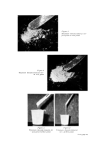
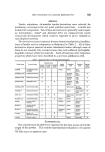
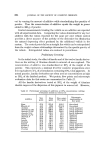
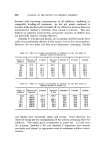
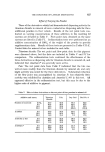
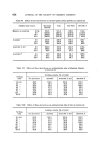
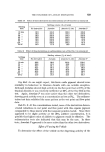
THE INFLUENCE OF LANOLIN DERIVATIVES 621 Sedimentation Test Equipment: 50 ml glass stoppered cylinders, graduated in 1.0 ml. Volumetric flasks of sufficient size to prepare the required amount of dispersing solution. Procedure: Prepare a 10% w/v solution of the additive in the vehicle. Place 40 ml of this solution in the 50 ml graduated cylinder. Add 4 g of the powder. Shake the cylinder 50 times, then allow it to stand for 1 hr to aid wetting. Shake the cylinder again 50 times, then allow it to stand for 2 hr, recording the sediment volume after 10, 20, $0, 40, 60, 90 and 120 min. Shake the cylinder again 50 times, then allow it to stand for 24 hr, recording the sediment volume after 10, 20, 30, 40, 60, 90 and 120 min and after 24 hr. Record the total volume of the dispersion in the cylinder. Calculation: Average the sediment volumes recorded during the first 2 hr rest period with the volumes recorded at comparable time intervals during the second 2 hr rest period. For each time interval, multiply the ml of sediment by 100 and divide by the total volume in the cylinder to convert the ml of sediment to % of total volume. MATERIALS Powders Although many diverse materials are incorporated in dispersed form in make up items, four major categories are most frequently used: Extenders and carriers, opacifiers and shade lighteners, inorganic pigments, and organic pigments. One example of each of these types was selected for this. investigation. Talc (No. 141 Alpine talc, U.S.P.) is an extender and carrier for the. pigments. The numerous grades available vary in purity, crystal type,. particle size range, chemical composition, linseed oil absorption, etc. Acid and water levigated U.S.P. talc ground to a particle size smaller than 325 mesh was used. This talc was almost entirely hydrous magnesium silicate, containing about 1% aluminium, iron and calcium oxides. The specific gravity was 2.79, and the linseed oil absorption was 45 lb/100 lb of talc.. Titanium dioxide (No. 328 T.G.A.) increases the opacity, improves the coverage and lightens the shades of pigmented make up items. Its tendency to agglomerate makes it one of the more difficult pigments to disperse and

622 JOURNAL OF THE SOCIETY OF COSMETIC CHEMISTS to maintain in a deflocculated state. Incomplete dispersion causes un- desirable alteration of the shade and consistency of formulations on ageing. Titanium dioxide with a particle size less than 325 mesh was used. This grade was better than 99% titanium dioxide and met U.S.P., N.F. and T.G.A. requirements. Its specific gravity was 3.9, and the linseed oil absorption was 30 lb/100 lb of pigment. Oxy Red (No. 3551 Pure Oxy Red) is one of a number of inorganic pigments suitable for the formulation of face and eye make ups. The pigment used contained 99% pure ferric oxide, and had a particle size less than 325 mesh. Its specific gravity was 5.18, and linseed oil absorption was 22-26. D. © C. Red No. 9 (No. 3009 Atomic Red) is a certified organic pigment used in face make ups, rouges and lipsticks. The organic pigments are generally difficult to disperse because of their tendency to agglomerate. Red No. 9 is the barium salt of 1-(4-chloro-osulpho-S-tolylazo)-2-naphthol. The pigment used had a particle size less than 325 mesh. Its specific gravity was 2.75, and linseed oil absorption was 41.6. Vehicles The vehicles selected represent two of the chemical types commonly used as carriers for powders in make up formulations. Mineral oil is a mixture of nonpolar inert hydrocarbons, available in a wide viscosity range. A low viscosity (70 vis) N.F. oil was selected as typical of the grades most frequently used in cosmetics. Although it is generally more difficult to disperse cosmetic powders in mineral oil than in either isopropyl esters or castor oil, mineral oil is the most widely used vehicle because of its low cost. isoPropyl palmitate is a low viscosity, slightly polar ester of a low molecular weight branched chain alcohol and a high molecular weight fatty acid. Esters of this type spread better and feel less oily than mineral oil. Cosmetic pigments are usually dispersed somewhat more easily in isopropyl palmirate than in mineral oil, but this ester is not used as exten- sively as mineral oil because of its higher cost. Castor oil is also commonly used as a vehicle, especially in lipsticks. Initial studies, however, indicated that systems utilizing this oil as the vehicle could not be evaluated accurately by the methods described because of the high viscosities encountered at room temperature. Because it is an important vehicle, modifications of the test method are being developed in •)rder to evaluate wetting efficiency in castor oil systems.
Purchased for the exclusive use of nofirst nolast (unknown)
From: SCC Media Library & Resource Center (library.scconline.org)