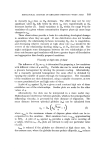
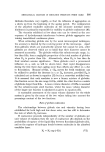
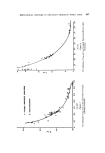
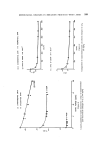
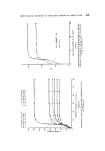
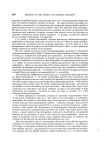
RHEOLOGICAL CHANGES IN EMULSION PRODUCTS WHEN AGED 593 in viscosity (%d) rises as Dm decreases. The effect may not be very significant until Dm falls below St, when %e• rises exponentially as Dm decreases further (7). Small variations in D• within the range 0-1t, for emulsions of a given volume concentration disperse phase (•) cause large changes in These observations provide a basis for calculating rheological changes in emulsions when they are aged. If size distribution does not broaden appreciably, the relationship between increasing D•, due to coagulation, and decreasing relative viscosity at high shear rate (Too) should be the reverse of the relationship showing rising 7oo as Dm decreases (8). One might anticipate some discrepancy between the two relationships at low shear rate because aged emulsions will show a greater degree of flocculation .and aggregation than freshly prepared emulsions. Viscosity at high rates of shear The influence of D• on n•o is determined by preparing a few emulsions with different values of • and D•. Particle size can be varied when using a pressure homogenizer by altering the pressure reading. Alternatively, for a manually operated homogenizer the same effect is obtained by varying the number of passes through the homogenizer. The viscosities of the emulsions are then determined, using a suitable viscometer, at two )r more preselected low and high rates of shear. A plot of nm against Dm for a given • and constant high rate of shear establishes one of the relationships. Similar plots are made for the other values ooe Alternatively, the data can be interpreted in a more useful way. Hydrodynamic interference between globules, which is the principal factor influencing viscosity, is governed by their distance of separation. The mean distance between spherical globules (am) can be calculated from where •m• is the maximum volume of disperse phase which can be in- corporated in the emulsion. Most emulsions have a •m• approximating to 74%. A plot of nm against ar• provides a single curve covering all • values, whereas '/•o - D•, plots are relevant to only one particular value of • (7). • is reduced if the globules are distorted at high shear rate. In the extreme case, where the globules become prolate ellipsoids, • reduces

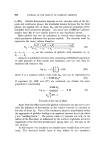
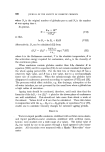
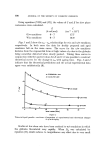
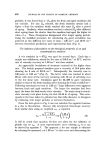
594 JOURNAL OF THE SOCIETY OF COSMETIC CHEMISTS to 53%. Globule deformation depends on the viscosity ratio of the dis- perse and continuous phases, the interfacial tension between the two fluid phases, the applied rate of shear, Din, and the physical properties of the emulsifier layer around the globules. At a shear rate of 1000 sec -• globules smaller than 10t, do not usually distort to any significant extent. Mean globule size can be calculated in several ways depending on which parameter influences the process studied. represents the mean volume diameter. D m •-3Jn• d•+ n2d• +nad: + n2 + na For viscosity work Dm n•d• n X (II) n•, n•, na, n• are the numbers of globules with diameters d•, d3 - - - d•. Analysis of published viscosity data concerning well defined suspensions of solid particles in fluid media and emulsions, and our own data for emulsions (9) indicates that log nm ---- C - 0.15 (III) where C is a constant which varies with D•, and can be represented by C = 0.0• (Din)' (•V) If equations (I), (III) and (IV) are combined one obtains the semi- quantitative relationship 0.036 Dm log • --: • O. 15 (V) Viscosity at low rate of shear Apart from the effect exerted by globule coalescence one has now to con- sider the influence of flocculation on the relative increase in viscosity at low rate of shear (n). Part of the continuous phase is immobilized within the aggregates of globules leading to an apparent increase in • to f•, where f is a "swelling factor." The precise value of f depends not only on the nature of the flocculate, as influenced by the number of globules involved, magnitude of the electrical double layer, ageing time, etc., but also on the rate of shear. In this respect w/o emulsions are studied more readily than o/w emul- sions. The electrical double layer is very diffuse in w/o emulsions.
Purchased for the exclusive use of nofirst nolast (unknown)
From: SCC Media Library & Resource Center (library.scconline.org)