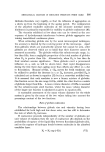
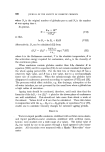
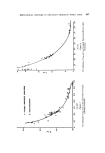
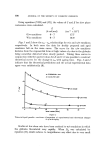
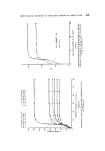
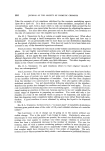
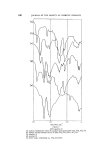
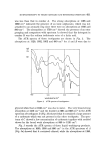
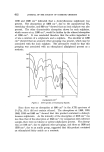
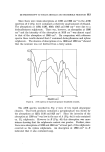
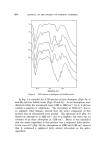
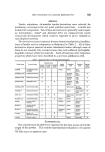
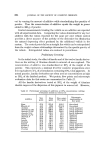
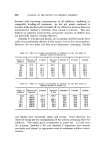
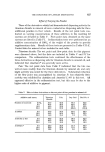
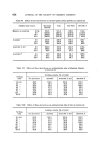
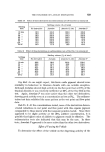
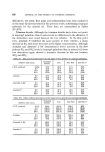
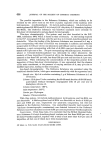
SPECTROSCOPY TO TOILET ARTICLES AND HOUSEHOLD PRODUCTS 609 After each spectrum had been recorded the prism was removed from its mount and cleaned by lapping on a polished pad with isopropanol for 60 sec. RESULTS AND DISCUSSION As has been found previously (4,5) the intensity of the bands increased as the angie of incidence decreased. It was further found, particularly for solid samples, that the resolution varied with the angie of incidence. In the case of sodium salts of fatty acids decreasing the angie of incidence improved the resolution in the region of 2800 crn -• but caused a deteriora- tion in the region of 1450 cm -•. For each type of sample it was therefore necessary to carry out a preliminary study to determine the optimum angle of incidence. Although the transmission of the Irtran II prism was less than that of the KRS-5 prism, in the wavelength range 900 to 650 crn -•, the former was used for highly alkaline samples since they caused the formation of a bright yellow film on the KRS-5 prism. Aqueous solutions produced a white "bloom" on the KRS-5 prism. Although no absorptions, due to the bloom, could be detected it appeared to absorb some of the solute and lead to erroneous results. Polishing with isopropanol on a lap for a few seconds was sufficient to clean the prism. Fig. 1 shows the ATR spectra of a sample of toilet soap, which con- tained ca. 11% moisture, together with those of two typical detergents used in soap-detergent combinations bars (cornbars), namely the sodium isethionate ester of coconut oil acid, and talloyl methyl tanride. Also shown are the ATR spectra of two combination bars. In the case of combar A (Fig. I c) the absorptions at 1550 and 1405 cm -•, due to an ionised carboxylic grouping, together with the absorption at 930 cm -• indicated that the major component was soap. The absence of absorptions within the wavelength range 1720 to 1740 cm -• showed that ester-containing components were absent. The absorption at 1640 crn -• was due to a tertiary amide grouping, since there was no evidence of the Amide II absorption at ca. 1515 cm -•. The spectrum also showed strong absorptions at 1185 and 1060 cm -• which could be ascribed to the asym- metric and symmetrical SO• stretching vibrations of an ionic sulphonate. Comparison with spectrum 1 (b) showed that the detergent in this combina- tion bar was a talloyl methyl tauride. The ATR spectrum of combar B {Fig. ld) showed absorptions at 1550, 1405 and 930 cm -x which indicated the presence of soap the soap content

610 JOURNAL OF THE SOCIETY OF COSMETIC CHEMISTS (c) (0 IIBOO 1400 IOOO 650 -I WAVELENGTH CM Figure 1 ATR spectra of (a) sodium isethionate ester of coconut oil acid R.COO CH• CH• SO s Na (b) talloyl methyl tauride R.CO N (Me) CH• CYI (OH.) SO• Na (c) combar A (d) cornbar B (e) toilet soap, containing ca. 11% moisture.
Purchased for the exclusive use of nofirst nolast (unknown)
From: SCC Media Library & Resource Center (library.scconline.org)