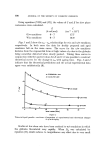
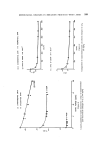
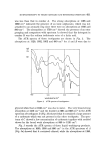
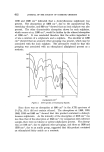
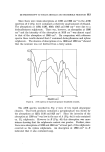
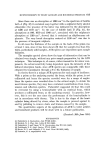
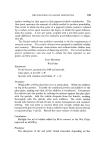
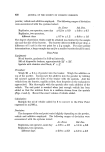
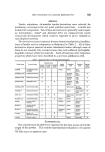
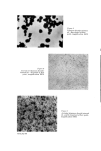
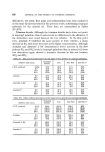
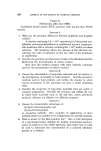
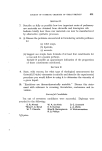
IR SPECTROSCOPY TO TOILET ARTICLES AND HOUSEHOLD PRODUCTS 613 Since there were weak absorptions at 1050 and 890 crn -• in the ATR spectrum of ½ (Fig. $c) it contained a relatively small amount of ethanol. The absorptions at 1180, 1150, 1040, 1015 and 840 cm -• were due to a dodecylbenzene sulphonate. There was, however, an absorption at 1090 cm -• and the intensity of the absorption at 1015 cm -• was almost equal to that of the absorption at 1040 cm -•. By comparison with reference spectra these results showed that C contained dodecylbenzene and xylene sulpl•onate. The absence of absorptions at ca. 1650 and 1550 crn -• showed that the nonionic was not derived from a fatty amide. 1800 1400 I000 650 w^VELE• F{gm'e 4. ATR spectra of liquid all-purpose household cleaners. The ATR spectra recorded in Fig. 4 were of two liquid all-purpose cleaners. That both products contained a pyrophosphate was shown by the absorptions at 1210, 1110 and 925 cm -•. Since the intensity of the absorption at 1180 cm -• was low in the case of A (Fig. 4a) it only contained ca. 1% sulphonate. However in B (Fig. 4b) this absorption was more intense showing that the sulphonate content was greater. Further, since there were absorptions at 1020 and 1040 cm -• at least part of this sulphonate occurred as the xylene sulphonate. An absorption at 1560 crn -• in B indicated that it also contained soap.

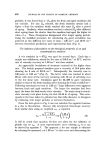
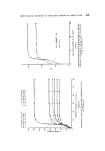
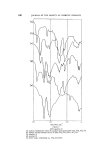
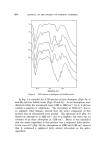
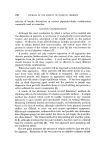
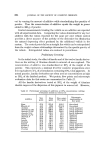
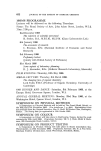
61z[ JOURNAL O1• THE SOCIETY OF COSMETIC CHEMISTS Figure 16OO 1300 I000 WAVELENGTH CM -I ATR spectra of shampoos and bubble baths. In Fig. 5 is recorded the ATR spectra of three shampoos (Figs. 5a, 5c and 5d) and two bubble baths (Figs. 5b and 5e). As no absorptions were detected within the wavelength range 1150 to 1250 cm -•, for A, it did not contain a sulphate or sulphonate. The absorption at 1110 cm -•, due to an aliphatic ether linkage, showed that the major component of this product was an ethoxylated fatty alcohol. The spectrum of B (Fig. 5c) showed an absorption at 1220 cm -•, due to a sulphate, but there was no evidence of an ether absorption at 1110 cm -•. Hence it was concluded that the active ingredient in this product was a sulphated fatty alcohol. In the case of C (Fig. 5d) the absorptions at 1220 and 1110 cm -• showed that it contained a sulphated fatty alcohol ethoxylate as the active ingredient.
Purchased for the exclusive use of nofirst nolast (unknown)
From: SCC Media Library & Resource Center (library.scconline.org)