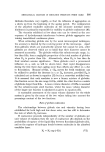
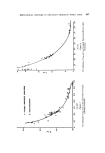
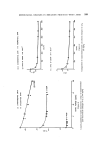
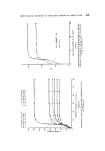
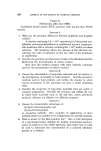
RHEOLOGICAL CHANGES IN EMULSION PRODUCTS WHEN AGED 595 Globules flocculate very rapidly, so that the influence of aggregation on • shows up from the beginning of the ageing period. The configuration of the absorbed emulsifier molecules at the oil/water interface {steric hindrance) is primarily responsible for stability to globule coalescence {10). The viscosity exhibited at low shear rate can be viewed as the con- sequence of hydrodynamic interference between globule aggregates con- taining immobilized continuous phase. When estimating globule size by the usual microscopical techniques, the accuracy is limited by the resolving power of the microscope. Apart from globules which are undoubtedly present but cannot be seen, other globules are observed which are so small that their diameter cannot be measured accurately. The globules within this submicroscopic range, i.e. less than 0.5•, form a negligible proportion of the total number of globules when Dm is greater than 10•. Alternatively, when Dm is less than 5• their numbers assume significance. These globules exert a pronounced influence on 7, and, as will be shown later, their rapid disappearance during the first three days ageing more than offsets any effect on v due to flocculation. Because of this, •- D• curves for fresh emulsions can be utilized to predict the decrease in • as Dm increases, provided Dm is calculated not as shown in equation (II) but in a somewhat modified way. It is assumed that each emulsion is now a binary mixture of globules. One fraction covers the size range 0-0.5•, whilst the other fraction consists of globules larger than 0.5t•. A mean volume diameter of 0.25• is assumed for the submicroscopic sized fraction, whilst the mean volume diameter of the larger size fraction is calculated as given in equation (II). A reasonable assessment of the mean volume diameter for the whole system is given by the mean of the two values taking into account the percentage content of the two fractions. Rate of globule coalescence The relationships between globule size and viscosity having been established for both high and low shear rates, one has still to determine the rate at which Dm increases. If coalescence proceeds independently of the number of globules per unit volume of emulsion then the rate of coalescence (K) depends on the probability of rupture of the liquid film between flocculated globules (11), and on the rupture of hydrogen bonds between molecules in the adsorbed emulsifier layer. N t = N O exp (-Kt) (VI)

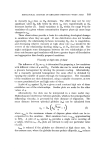
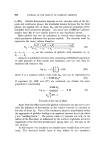
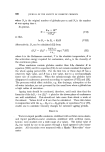
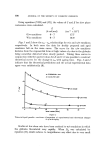
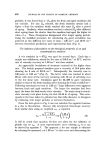
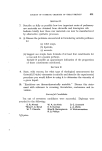
596 JOURNAL OF THE SOCIETY OF COSMETIC CHEMISTS where N O is the original number of globules per cc and N t is the number at any ageing time t. In general, so that, 6 • x 10 '• N = (VII) :• (Din) a in D t: in D O + Kt/3 (VIII) Alternatively, D t can be calculated (12) from 8kT• t (Dr) a ----(Do) • + • exp (-•/RT) (IX) •o where k is the Boltzmann constant, T is the absolute temperature, E is the activation energy required for coalescence, and % is the viscosity of the continuous phase. When emulsions contain globules smaller than 0.5, diameter K in equation (VIII) and E in equation (IX) do not remain constant throughout the whole ageing period (13). For the first two or three days K has a relatively high value, and E has a low value, due to a correspondingly faster rate of coalescence. When the submicroscopic size •1obules have disappeared coalescence proceeds according to equations (VIII) and (IX). The processes which effect stability, e.g. film drainage, adsorption at the oil-water interface, are not governed by the usual laws when a globule has a high radius of curvature. Ageing tests should be continued, therefore, until such time that the linearity of the lnD t - t or (Dr) * - t plots for the slower phase of coalescence are well established. This should not take more than about a week at the utmost. Values for K or E can then be calculated. These data taken in conjunction with the '•o - D•, or ,• - D., graphs, or equations (V) or (VI), enable one to calculate viscosity changes for extensive ageing periods. RESULTS Waterdndiquid paraffin emulsions stabilized with sorbitan mono-oleate, and liquid paraffin-in-water emulsions stabilized with sorbitan mono- laurate, were studied over a wide range of • values. The initial value of D., was varied by one to six passes through a hand operated valve homo- genizer. All viscosities were measured with a Haake "Rotovisko" visco- meter
Purchased for the exclusive use of nofirst nolast (unknown)
From: SCC Media Library & Resource Center (library.scconline.org)