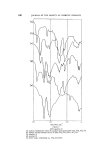
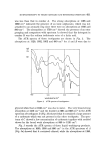
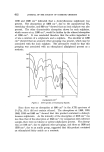
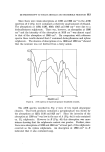
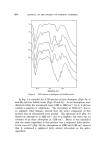
J. Soc. Cosmetic Chemists 16 607-615 (1965) ¸ 196fi Society of ½osmeti• Chemists of Great Britai• Application of Attenuated Total Reflectance IR spectroscopy to toilet articles and household products, 1., Qualitative analysis N. A. PUTTNAM, S. LEE and B. H. BAXTER* SynOl•Sis--The application of IR spectroscopy to the identification of components in toilet articles and household products using a special reflection technique, i.e. Attenuated Total Reflectance, is described. This technique, which is essentially independent of sample thick- ness, permits spectra to be obtained from bulk samples which are equivalent to those obtained by transmission through thin films. Such a procedure overcomes the experimental diffi- culties encountered when attempting to study these types of products by transmission spectroscopy. Examples are quoted of the application of ATR, without any prior sample preparation, to soap-detergent combination bars, toothpastes, washing-up products, all-purpose cleaners, shampoos and bubble baths. INTRODUCTION The recent advent of a special reflection technique, namely Atten- uated Total Reflectance (ATR), has greatly facilitated the application of infrared spectroscopy to toilet articles and household products. ATR was developed by Fahrenfort (1) for the determination of optical constants and as a means of obtaining intense spectra from samples which were difficult or unamenable to study by normal transmission techniques. Simultaneously Harrick (2) developed a multireflection technique to obtain spectra from surface layers. In this case the surface was sampled many times and hence weak absorptions were magnified. In ATR the radiation incident on an interface (at angles of incidence greater than the critical angle) between the sample and an analysing crystal of higher refractive *Research and Development Dept., Colgate-Palmolive Ltd., Manchester, $. 607

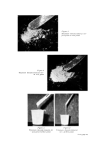
608 JOURNAL OF THE SOCIETY OF COSMETIC CHEMISTS index will be totally reflected at those wavelengths where the sample shows no absorption. However, at wavelengths where the sample absorbs, part of the incident radiation will be absorbed causing an attentuation of the reflected radiation. Such an effect produces a spectrum which strongly resembles the transmission spectra, although the shape of the bands will be different (3). Since the technique depends upon attenuation of the reflected energy at the interface it is essentially independent of sample thickness. Hence, by this technique spectra can be obtained from bulk samples which are equivalent to those obtained by transmission through thin films. Such a technique eliminates (a) the need to obtain reproducible thin films, (b) the difficulties encountered in filling short path-length cells with viscous liquids, and (c) the troublesome interference patterns found with such cells. Also, for aqueous solutions there is no need to compensate for the very strong solvent absorptions. EXPERIMENTAL The ATR spectra were recorded on Unicam SPlO0 and SP200 IR spectrometers using a TR-3 ATR attachment, manufactured by Research and Industrial Instruments Co. This attachment provided for the exami- nation of solid or liquid samples at angles of incidence within the range 26 to 63 ø. A KRS-5 prism was used as the analysing crystal for all except highly alkaline samples, where an Irtran II prism was employed. Since the transmission of both prisms was only 60 to 70% it was necessary to attenuate the reference beam. This attenuation was carried out by placing a beam attenuator in the reference beam and adjusting to an absorbance value of 0.07 to 0.1 at a wavelength where the sample showed no absorption. For solid products, the sample was pressed against the back face of the prism with a clamping plate. For this type of sample the angle of incidence was between 38 and 33 ø and the spectrum recorded over the wavelength range 600 to 5000 crn -•. If the sample was a cream, a thick layer was smeared onto the back face of the prism and the spectrum recorded as described above. For liquid products a backing plate, with a Teflon seal, was fitted to the prism mount to form a sealed cell, approximately 2 mm thick, on the back face of the prism. The sample was then introduced into this cell through the filler-ports with a syringe, and the spectrum recorded at an angle of incidence between 33 and 40 ø .
Purchased for the exclusive use of nofirst nolast (unknown)
From: SCC Media Library & Resource Center (library.scconline.org)