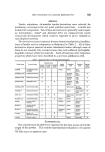
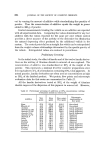
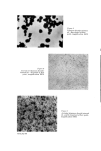
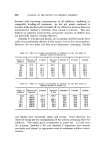
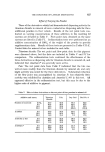
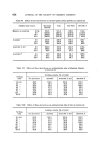
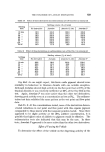
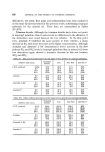
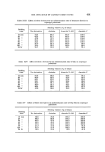
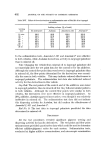
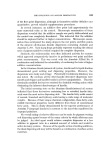
,634 JOURNAL OF THE SOCIETY OF COSMETIC CHEMISTS Until this ideal dispersing agent or combination of agents is found, the most efficient additive for any application must be the one that meets the primary dispersing requirements of each individual system. If the lowest possible ratio of additive to pigment is the most important consideration, then a derivative such as Amerlate P would be utilized. If, on the other hand, the primary requirement is a system containing a minimal amount •)f vehicle, then an additive w•hich gives the lowest flow point should be selected. A cetulan, which gave exceptionally low flow points at •slightly higher additive concentrations, would be the preferred dispersing aid. The type of data presented in this study can be used to make such .selections. It is possible that further investigations now being conducted on a broader range of materials, including homologous series, may disclose underlying concepts relating chemical structure to dispersing action. Furthermore, analysis of a greater volume of data may allow reliable -prediction of wetting activity based on established patterns of behaviour. SUMMARY AND CONCLUSIONS Modified wet point and flow point procedures are described. Their validity as quantitative measurements of the wetting and dispersing activity of lanolin derivatives in several cosmetic pigment/vehicle systems is demonstrated. The value of the sedimentation test and microscopic examination of the flow point dispersions was illustrated. All the lanolin derivatives evaluated by the described tests exhibited .significant wetting and dispersing action. This activity was found to be .specific so that data obtained in any additive/pigment/vehicle system could not be applied to another system differing by even one component. Simi- larly, neither the effective level of wetting aid nor the volume of vehicle required to reach a desired result could be predicted. Of the derivatives studied in some detail, Amerlate P was the most versatile, demonstrating wetting and dispersing activity at relatively low •concentrations in mineral oil and isopropyl palmitate for the three inorganic pigments. There were indications that concentrations of Amerlate P higher than 20% would achieve dispersion of the organic colour. While Amerlate P (isopropyl lanolate) exhibited excellent activity, isopropyl palmitate .showed very little activity in the combinations tested. A cetulan demonstrated generally good wetting activity with some specificity for pigments and vehicles. No pattern was observed which .could explain or predict this specificity.

THE INFLUENCE OF LANOLIN DERIVATIVES 635 Amerchol L-707 exhibited definite dispersing activity for the two metal oxides in both vehicles and showed modest activity for talc. The effect of Amerchol 1 -707 was insignificant in dispersing the organic colour. Lanolin derivatives provide the formulation chemist with effective pigment dispersing aids which have valuable moisturizing, conditioning and emollient effects as well. Evaluating them by the described methods simplifies the problem of selecting the derivative which will be most effective for a specific pigment/vehicle system. ACKNOWLEDGEMENTS The authors wish to express their appreciation to Mrs. M. McCracken and Mr. R. Hergenrother for their assistance in conducting the large number of tests required to collect the data presented in this paper. (Received: 78th February 1965) REFERENCES (1) Ammons, V. G. Ind. Eng. Chem. $$ 40 (April 1963). (2) Torry, L. P. in Hibbott, H. W. Handbook of Cosmetic Science 304-305 {1963) (Pergamon Press, Oxford). (3) Jakovics, lV[. Proc. Sci. Sect. Toilet Goods Assoc. 26 9 (December 1956). (4) Griffin, W. C. in Sagafin, E. Cosmetics 1030-1031 (1957) (Interscience, New York). (5) Holtzman, H. in DeNavarre, 1V[. G. The Chemistry and Manufacture of Cosmetics, 2rid Ed. I 101 (D. Van Nostrand Co., Princeton). (6) Bews, I. C. R. and Fisk, N. R. Am. Perruiner Cosmetics 79 89 (October 1964). (7) Asbeck, W. K. and Van Loo, M. Ind. Eng. Chem. 41 1470 (September 1949). (8) Daniel, F. K. O•c. Dig. Federation Paint Varnish Production Clubs 344 635 (1953). (9) ibid. 332 633 (1952). (10) Amerchol Lanolin Derivatives (1964) (American Cholesterol Products, Edison). (11) Brit. Pat. 965, 849. (12) Brit. Pat. 785, 465 U.S. Pat. 2, 725, 334. DISCUSSION MR. E. W. CLARK: In the experiment on sedimentation rate the most effective additive appeared to be ,4ruerlate P. This is a solid substance and presumably increased the viscosity of the mineral oil. Is it possible that this increased viscosity, as opposed to a dispersing effect, was at least partially responsible for the slower sedimentation ? MR. CONRAD: Yes, it is possible. We have tried lanolin in the same series and in other series which we have not presented here, and ,4ruerlate P seemed to be quite different from lanolin in its effect. The ,4rnerlate P is a soft solid the melting point does not differ much from that of lanolin, just one or two degrees higher. MR. E. W. CLARK: In the Tables you were comparing ,4rnerlate P with two other derivatives, and the other derivatives were thin liquids, so there would be a considerable difference in viscosity. MR. CONRAD: Yes.
Purchased for the exclusive use of nofirst nolast (unknown)
From: SCC Media Library & Resource Center (library.scconline.org)