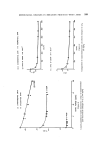
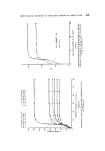
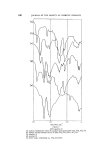
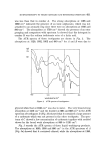
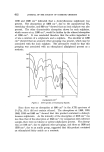
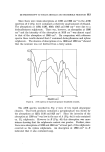
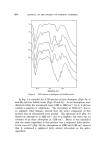
IR SPECTROSCOPY TO TOILET ARTICLES AND HOUSEHOLD PRODUCTS 615 Since there was an absorption at 1560 crn -• in the spectrum of bubble bath A (Fig. 5b) it contained soap together with a sulphated fatty alcohol ethoxylate the presence of the latter was indicated by the absorptions at 1220 and 1110 crn -•. In the case of bubble bath B (Fig. 5e), the absorptions at 840, 1010 and 1040 cm -•, associated with the sulphonate absorption at 1180 cm -•, showed that it contained an alkylbenzene sul- phonate. The very broad absorption centred at 1100 cm -• was due to the presence of inorganic sulphate. In all cases the thickness of the sample on the back of the prism was at least 1 mm, since it has been shown (6) that for samples less than 10• thick, particularly solid samples, ATR spectra are dependent upon sample thickness. The examples quoted above show the type of information that can be obtained very simply, without any prior sample preparation, by the ATR technique. This technique is, of course, rather insensitive for minor com- ponents, the actual sensitivity being dependent upon the intensity of the infrared absorption bands, since ATR spectra are comparable with those obtained by transmission through a 5 to 10• thickness of sample. In theory there is a unique ATR spectrum for each angle of incidence. With a prism as the analysing crystal the beam, within the prism, is not collimated and hence the spectra recorded were for a range of angles. Since the spectra were recorded close to the critical angle, to obtain the most intense spectra, they may have contained contributions from trans- mission and reflection spectra. Fahrenfort suggested (1) that this could be overcome by using a hemi-cylinder with an external focus, which produces a collimated beam, as the analysing crystal. In practice, how- ever, this is not the case since the performance of the hemi-cylinder is not in accordance with theory. This is due to the shape of the hemi- cylinder being altered by stress, when the sample is pressed against it, and by polishing to remove dents and bruises caused by the sample. The quantitative aspects of the application of ATR to toilet articles and household products will be dealt with in a future publication. (Received: 30th June 7965) REFERENCES (1) Fahrenfort, J. Spectrochim. Acta 17 698 (1961). (2) Harrick, N.J. Phys. Rev. Letters 4 224 (1960). (3) Fahrenfort, J. and Visser, W. M. Spectrochim Acta 18 1103 (1962). {4) Polchlopek, S. E. Appl. Spectry. 17 112 (1963). (5) Harris, R. L. and Svoboda, G. R. Anal. Chern. 34 1655 (1962). (6) Puttnam, N. A. unpublished work.

J. Soc. Cosmetic chemists 16 617-636 (1965) ¸ 1965 so•.i•ty o/ Cos,n•tic c•istso/ •t B,wi,• The influence of lanolin derivatives on dispersed systems, 1. ß ß ß The dsperson of pgments nonaqueous liquids L. I. CONRAD, H. F. MASO, and SHIRLEY A. DeRAGON* Presented at the Symposium on "Emulsions", organized by the Society of Cosmetic Chemists of Great Britain at Harrogate, Yorks, on 1st April •965. Synopsis--The dispersing activity of several lanolin derivatives is studied by means of modified wet and flow point procedures which are described in detail. Sedimentation tests and microscopic examination are used as supplementary aids. These procedures reveal significant pigment wetting and deflocculating activity for lanolin derivatives when used as additives. The wet and flow point measurements provide quantitative data which can be used to determine efficient additive/pigment ratios for each system studied. Because of the specific action of the wetting additives no single lanolin derivative can be recommended for all pigment/vehicle systems, but an ideal dispersing aid might utilize a combination of these surface active materials. INTRODUCTION The literature contains many references to the problems of dispersing powders in nonaqueous liquid vehicles (1-6). Cosmetic chemists who develop pigmented formulations have to overcome flocculation, streaking, hard settling, viscosity changes and similar vexations by strictly empirical methods. Few chemists in any field can ignore pigment technology, and yet there is no single practical method based on overall theoretical concepts for evaluating this type of wetting. Quantitative data on pigment wetting efficiency, if available, could reduce the time taken up by trial and error experimentation and provide comparative information in a form which would allow selection of the most efficient components for a particular system. This study supplies such data for the first time on the wetting *American Cholesterol Products, Inc., Edison, N.J., U.S.A. 617
Purchased for the exclusive use of nofirst nolast (unknown)
From: SCC Media Library & Resource Center (library.scconline.org)