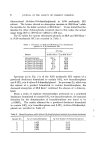
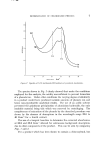
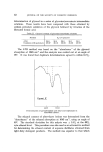
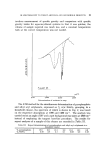
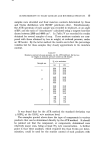
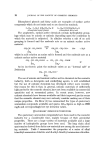
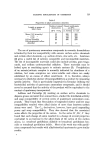
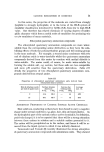
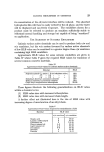
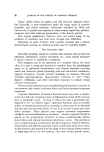
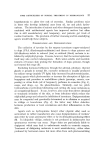
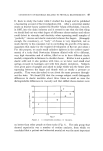
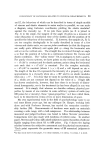
IR SPECTROSCOPY TO TOILET ARTICLES AND HOUSEHOLD PRODUCTS involves measurement of specific gravity and comparison with specific gravity tables for aqueous/ethanol systems in that it was quicker, the volume of sample required was much less, and a constant temperature bath at the correct temperature was not needed. o ! ! i 4-000 3ooo 20o0 Determination of moisture in soap. The ATR method for the simultaneous determination of pyrophosphate and alkyl aryl sulphonate, expressed as % w/w NaSO•- grouping, in a household cleaner, the spectrum of which is shown in Fig. 2, was based on the respective absorptions at 1090 and 1180 cm-L The analysis was carried out at an angie of 35 ø and a spot background was taken at 1300 cm -• instead of employing the tangent base4ine procedure. The results for repeat analyses of a sample of this cleaner are recorded in Table III. Table III Repeat determinations of pyrophosphate and alkyl aryl sulphonate in a household cleaner % pyrophosphate 10.0 10.1 10.1 9.9 10.1 10.1 9.8 % NaSOa- 2.15 2.0 2.1 2.1 2.05 2.0 2.15

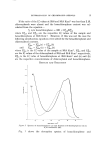
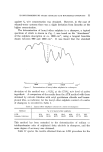
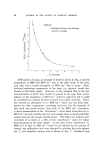
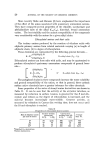
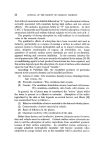
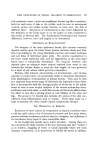
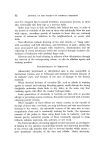
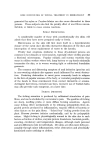
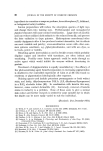
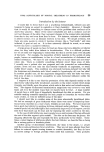
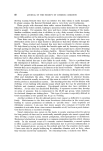
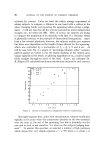
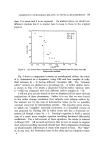
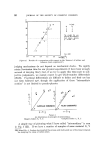
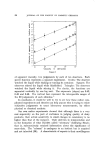
14 JOURNAL OF THE SOCIETY OF COSMETIC CHEMISTS ATR spectra of soaps, an example of which is shown in Fig. 3, showed absorptions at 2800 and 2910 cm -• due to the alkyl chain of the fatty acid salts and a broad absorption at 3410 cm -• due to water. Other hydroxyl-containing components in the soap, e.g. glycerol, would also absorb in this latter region. However, it was assumed that at the low concentrations at which they would be present in the soap their contri- butions to the absorption at 3410 cm -• could be neglected and it could be considered as a binary mixture of water and a fatty acid salt. Water also showed an absorption at ca. 1640 cm% which was free from inter- ference by other components containing hydroxyl, but the intensity of this band was much weaker than that of the 3410 cm -• absorption. A direct measurement of the "absorbance" of the water absorption at ca. 3410 cm -• was not possible since for each sample there is non-reproducible contact between the sample and the prism. This effect was found to give variations of as much as + 12% in the "absorbance" values for repeat determinations on the same sample. As the ratio of the "absorbance" at 2800 cm -• to that at 3410 cm -• would not be affected by the amount of contact, the calibration curve was obtained by plotting this ratio against 'the % w/w moisture content and is shown in Fig. 4. Standard soap
Purchased for the exclusive use of nofirst nolast (unknown)
From: SCC Media Library & Resource Center (library.scconline.org)