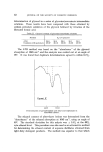
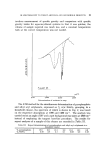
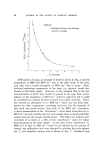
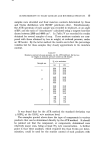
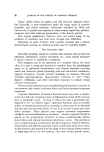
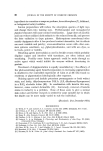
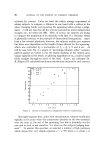
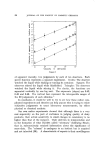
54 JOURNAL OF THE SOCIETY OF COSMETIC CHEMISTS -• 10 4 • i0 3 • 5 I0 • ,-, :3 2 I0 o 5 • 2 I i i i i I0 I0 • 10 3 10 4 I0 • Viscosity in centipoises Figure 6 of. apparent viscosity, two judgements by each of ten observers. Each power function represents a separate experiment. Circles: The observer watched the liquid while shaking or turning its container. Squares: The observers stirred the liquid while blindfolded. Triangles: The observers watched the liquid while stirring it. For clarity, the functions are separated vertically by one log unit. The exponents (slopes) are 0.42, 0.43 and 0.46. The vertical bars represent the interquartile ranges of the 20 judgements of each stimulus." In conclusion, it would be well to try to see how these rather com- plicated experiments and theories can help anyone who is trying to relate subjective judgements to exact laboratory measurements, by either physical or chemical analysis. Our own earlier experiments showed that although there is a very real superiority on the part of craftsmen in judging quality of dairy products, their actual sensitivity to small changes in consistency is no higher than that of the inexpert. Their skill lies in interpretation and in the formation of what Bartlett called "schemata" (following Head) that is, subconsciously retained information about the significance of sense-data. The "schema" is analogous to an instinct but is acquired and not inherited (26). A characteristic of experts is their unwillingness

CONSISTENCY OF MATERIALS RELATED TO PHYSICAL MEASUREMENTS 55 to analyse their general judgements of consistency into separate physical components. We once asked a number of cheese experts, and others, to score a batch of cheese separately for firmness, springiness and crumbliness. There was little physical correlation between these properties among the samples given and the inexpert had, in general, no difficulty in giving us separate orders for the three. But the experts always gave the same order they could not get away from the combined concept of "body," which includes all that can be felt with the fingers. When we did get a number of separate subjective assessments of different rheological characteristics, as well as several physical tests, we generally sorted out the correlations, i.e. simplified the correlation matrix, by means of Multiple Factor Analysis but I have already described this technique to you in some detail (1). Just how the expert reaches his conclusions and interprets his sense data we do not know, but we used to think that such judgements are mainly concerned with kinaesthetic (joint and muscle) sensations rather than with cutaneous (skin) sensitivity. More recent experiments by Harper have, however, thrown some doubt on this conclusion. Much more work requires to be done. The rheologist, as a physicist, naturally likes his concepts and especially his definition of "physical properties" to come within the range of Continuum Theory. Properties should have well-defined dimensions, generally expressed in powers of mass, length and time, should be invariant to changes in coordinate systems, and so forth. Unfortunately, human beings do not judge consistency in these terms or if they do try to do so, they are attempting to bridge the gap between subjective and objective measurements in a somewhat artificial way. Fundamentally, my own view is that the gap is unbridgeable but I am also quite confident that physical measurements, whether of primary physical properties or of more complex behaviour, can most certainly help - but not replace the craftsman. The greatest difficulty facing those working in this field is to persuade the craftsman that this is so and that we are not secretly attempting to replace him by machines. (Received: 7th October 1964) ACKNOWLEDGEMENTS The author gratefully acknowledges permission by the following to reproduce the illustrations: The Royal Society for Fig. 1. The Editor, American Journal of Psychology, for Figs. 2 and d.
Purchased for the exclusive use of nofirst nolast (unknown)
From: SCC Media Library & Resource Center (library.scconline.org)