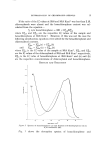
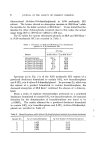
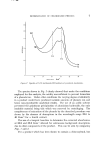
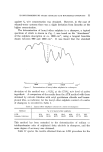
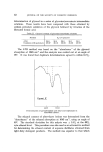
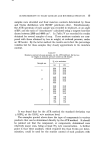
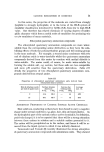
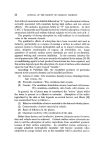
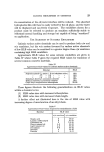
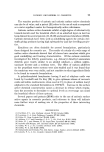
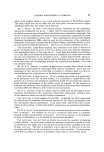
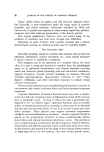
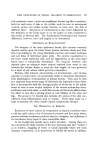
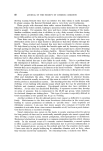
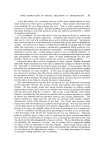
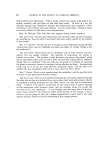
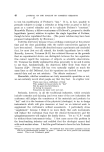
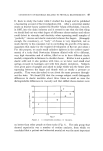
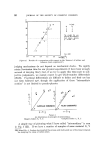
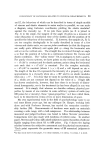
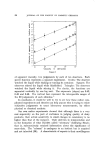
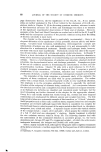
IR SPECTROSCOPY TO TOILET ARTICLES AND HOUSEHOLD PRODUCTS 11 against % w/w concentration was obtained. However, in the case of ethanol-water systems there was a slight deviation from linearity at the higher concentration. The determination of lauryl ether sulphate in a shampoo, a typical spectrum of which is shown in Fig. 1, was based on the "absorbance" of the sulphate absorption at ca. 1220 cm -•, using a tangent base-line drawn between 990 and 1330 cm -•. It was found that the standard I I i I I /.400 I ,Zoo I 0oo C,•-- I Fig,tre 1. Determination of lauryl ether sulphate in a shampoo. deviation of the method was q-0.2% at the 17.0% w/w level of active ingredient. A comparison of the results from the ATR method with those obtained by cationic titration with cetyl pyridinium chloride and bromo- phenol blue, as indicator, for the lauryl ether sulphate content of a series of shampoos is recorded in Table I. Table I Lauryl ether sulphate content of a series of shampoos Method % w/w lauryl ether sulphate ATR 16.4 19.0 16.8 16.6 16.8 17.2 19.1 Cationic titration 16.26 19.05 16.71 16.67 16.95 17.11 19.0 This method has been extended to the determination of sodium or triethanolamine salts of sulphated fatty alcohols in shampoos, and the same degree of accuracy was obtained. Table II quotes the results obtained from an ATR procedure for the

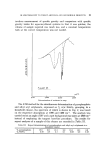
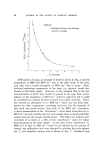
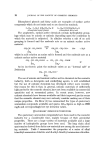
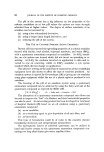
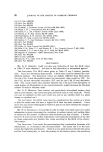
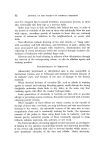
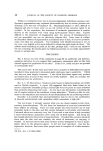
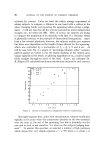
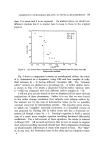
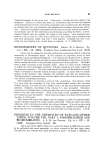
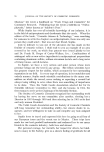
12 JOURNAL OF THE SOCIETY OF COSMETIC CHEMISTS determination of glycerol in a series of glycerine/sarcosinate intermediate solutions. These results have been compared with those obtained by sodium periodate oxidation of the glycerol followed by titration of the liberated formic acid. Table II Glycerol content of glycerine/sarcosinate solutions Method % w/w glycerol ATR 29.8 $0.0 29.9 $0.1 30.0 Oxidation with periodate 29.57 30.12 30.08 30.02 29.93 The ATR method was based on the "absorbance" of the glycerol absorption at 1045 cm -• and the analysis was carried out at an angle of 35 ø . It was found that duplicate determinations agreed to within 0.1ø/0 . I Determination of pyrophosphate and alkyl aryl sulphonate in household cleaner. The ethanol content of after-shave lotions was determined from the "absorbance" of the ethanol absorption at 1045 cm% using an angle of 40 ø. The standard deviation for this anlysis was :• 1.5% at the 50ø//0 w/w ethanol level. This procedure was also used as an alternative method for determining the ethanol content of aqueous distillates obtained from light duty detergent products. The method was superior to that which
Purchased for the exclusive use of nofirst nolast (unknown)
From: SCC Media Library & Resource Center (library.scconline.org)