J. Soc. Cosmetic Chemists 17 17-27 (1966) ¸ 1900 Society of Cosmetic Chemists o.oe Greai Britain Cationic emulsifiers in cosmetics K. M. GODFREY* Presented at the Symposium on "Emulsions", organised by the Society of Cosmetic Chemists of Great Britain at Harrogate, Yorks, on 31st March 1965. Synopsis The use of cationic surface active chemicals as emulsifiers in cosmetic products has been a relatively recent development. Their properties are reviewed and methods of making use of them are discussed. The sensitizing of emulsions to "break" on contact with surfaces to which they are applied has particular interest to the formulatot of cosmetic products. INTRODUCTION Surface active chemicals are conveniently classified as anionic, nonionic, cationic or ampholytic depending upon their ionization properties in solution. Molecules, of surface active chemicals which ionize, are anionic or cationic according to which ion contains the hydrophobic grouping. Compounds such as soaps, alkyl sulphonates, alkyl aryl sulphonates, salts of sulphated alcohols, etc. are anionic as the negative ion contains the hydrophobic, long chain grouping, e.g. (CH a. (CH•)•6 COO)- Iqa + sodium soap of fatty acid (CH a. (CH2)•.• OSOa)- Na+ sodium cetyl sulphate When the ion containing the hydrophobic, long chain group, is positive the compounds are cationic, e.g. CH a + R--N--CH a X- (CH a. (CH•)•7.NHa)+ X- I CH a amine salt quaternary ammonium salt *Armour Hess Chemicals Ltd., Leeds, Yorks. 17

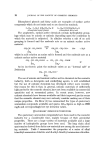
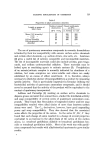
18 JOURNAL OF THE SOCIETY OF COSMETIC CHEMISTS Ethoxylated phenols and fatty acids are examples of surface active compounds which do not ionize and so are classed as nonionic. C, I-I•,. C• I-I4.0 (CH,.CH,.O)x I-I C•, Ha, CO0(CI-I,CH,O)x H ethoxylated nonyl phenol ethoxylated fatty acid The amphoteric, surface active chemicals contain hydrophobic group- ings which may be anionic or cationic depending upon the conditions to which the material is subjected. In alkaline solution a salt of an acid grouping is formed and the molecule acts as an anionic surface active material. NaOH CHa. TH . CH• COOH •--- CHa.•H . CH 2 COO- Na+ + H•O NH• NH2 whilst in acid solution an amine salt is formed and the molecule acts as a cationic surface active material CHs. CH.CH•COOH • CH 8.CH.CH•.COOH NH• NHa+ At its iso-electric point the molecule exists as an "internal salt" or Zwitterion CH a. CH. CH•COO- I NHa+ The use of anionic and nonionic surface active chemicals in the cosmetic industry, both as detergents and emulsifying agents, is well established but the use of cationic chemicals has developed rather more recently. One reason for this is that, in general, cationic materials of sufficiently high purity for the cosmetic chemist, have not been available in commercial quantities and at economical prices. In recent years, however, new cationic chemicals have become available and their improved purity means that the cosmetic chemist may now seriously consider making use of their unique properties. Du Brow (1) has summarized the types of quaternary ammonium compounds available and quotes LD50 figures as high as 2000 mg/k and correspondingly low eye irritation values. •)UATERNARY AMMONIUM COMPOUNDS The quaternary ammonium compounds have been used in the cosmetic industry for a considerable time, mainly because of their germicidal properties. There are a large variety of materials available and a large number of hydrophobic groups have been used. The long chain alkyl quaternaries derived from fatty raw materials are among the most interest- ing materiMs. Table I summarizes the properties of a series of alkyl trimethyl ammonium chlorides and di-alkyl dimethyl ammonium chlorides.
Purchased for the exclusive use of nofirst nolast (unknown)
From: SCC Media Library & Resource Center (library.scconline.org)