46 JOURNAL OF THE SOCIETY OF COSMETIC CHEMISTS viscosity, elastic moduli, relaxation times, etc., and terms which denote general similarities of behaviour, such as consistency, body, etc. If we give these latter terms, which I have called "denotative"* precise physical definitions, we shall have to invent new terms to replace them. It is better to invent new terms for the "connotative" physical properties where these are needed. So we will keep "consistency" as a very general term. It is the purpose of rheology to express the consistency of materials by means of numbers and this can, of course, be done both by subjective assessments and by instrumental tests. The question arises whether we can regard as a true "measurement," numbers which are scored by sub- jective tests, e.g. "very firm = 5, firm = 4, medium = 3, soft = 2, very soft = 1." I think we must accept the word "measurement" in its widest sense, so long as we are careful to appreciate that there is a hierarchy of types of measurement and that certain statistical treatments are applicable only to certain types of measurement. It is also interesting that there is a hierarchy of the senses. An appreciation of the visual arts and of music is always regarded as desirable. Exact science is based almost entirely (some say entirely) on visible pointer readings for which we require only one colour-blind eye. A few scientific measurements, such as electrical resistance, are sometimes made through hearing. It is hard to find exact physical correlates for taste and still harder for smell, and the perfumers and restaurateurs will agree that there is still some prejudice against too great an interest in their products. Aesthetics deals hardly at all with the "feel" of materials. Is there any explanation for this strange parallelism? In our own day, the most intensive studies in this field of measurement theory have been made by S. S. Stevens (3)$, who defined "measurement" as "the assignment of numerals to things so as to represent facts and conventions about them." Although he has later proposed a somewhat more complex classification, his earlier grouping of types of measurement will serve for our present purpose. Stevens originally proposed four types of measure- ment, easily memorized because their initial letters form the French word for "black" (NOIR). Nominal measurements, which some of us would hardly include as measurements at all, represent the arbitrary numbering of people or things *The terms "denotative" and "connotative" have changed their meaning somewhat in the course of time (2). }Stevens has published so many admirable papers on measurement that it is hard to know which to quote. Perhaps the best fairly recent expression of his views is to be found in (4).

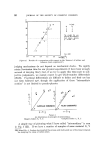
CONSISTENCY OF MATERIALS RELATED TO PHYSICAL MEASUREMENTS 47 and this really does no more than substitute a number for a name, as is sometimes done in the army or in prisons. Ordinal measures are well illustrated by the scoring for firmness dis- cussed above. There is no evidence that the numbers 5- 1 are evenly spaced and we cannot write, for instance, 5-4 = 2- 1 but the order is meaningful (5). Interval scales, as the name implies, presume an equality of interval between the members, e.g. degrees on the Fahrenheit temperature scale, but the zero is arbitrary and sometimes indeterminate. Interval scales cannot be inter-converted by a single multiplication, whereas the highest category, ratio scales, such as lengths, masses, degrees Kelvin, etc., can. Thus, if we ask the old question "Can sensations be measured?" Stevens would reply that it depends on what type of measurement you have in mind. This is, I think an appropriate stage to turn back to the earlier history of this controversial question, though only a very brief outline can be given here and some of the story is doubtless already well known to you [if not, it can be found in a book by Boring (6)]. In 1834 Weber found an empirical experimental law that the just noticeable difference (j.n.d.z•E) in the intensity of a stimulus, say a beam of light, is proportional to the intensity (E) of the stimulus. This is approximately true in many cases and there can be no theoretical objection to it in so far as it works. However, in 1850 (apparently unpublished until 1860) Fechner extended the "law" by making certain assumptions which were strongly challenged by many workers, including Tannery (1875) and later by Bergson (7). Fechner assumed that our consciousness of an increase of stimulus is produced by an increase of sensation (z•S). It is further assumed that equal increases in j.n.d.'s correspond to equal increments of sensation so that z•S = C f(E)' C being a constant. The deltas are then arbitrarily replaced by d's and, assuming Weber's law, we have, by integration, S = C in (E/Q), Q being a constant. This very dubious equation is, unfortunately, often linked with the name of Weber as "the Weber- Fechner law." Tannery and Bergson claimed that sensations are not "quantities" at all and cannot, therefore, be expressed numerically. Delboeuf, in Ghent and later in Liege, added a number of terms to Fechner's equation, mainly to obviate troubles with limiting conditions. He also performed experiments in which he claimed that it was possible
Purchased for the exclusive use of nofirst nolast (unknown)
From: SCC Media Library & Resource Center (library.scconline.org)