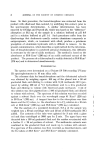
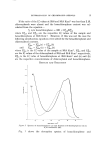
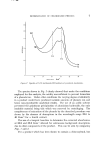
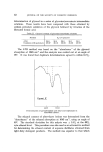
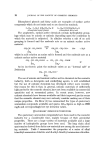
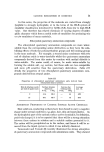
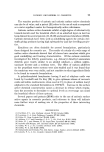
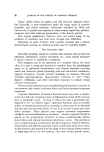
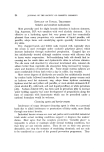
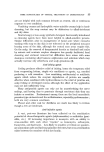
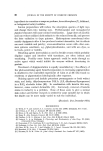
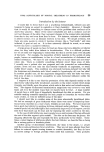
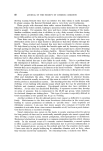
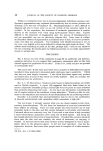
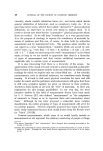
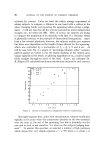
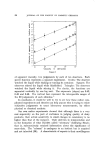
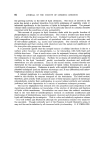
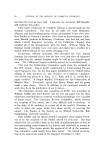
50 JOURNAL OF THE SOCIETY OF COSMETIC CHEMISTS criterion for success. Later we tried the rather strange experiment of asking subjects to compare a bitumen in one hand with a rubber in the other, changing hands and repeating the squeezing before giving a judge- ment. I will not here list all the obvious precautions about temperature changes, etc., for which see (16). Here, of course, our subjects are trying to compare the magnitude of an elasticity with that of a viscosity, which is physically contrary to the principle of dimensional homogeneity. Apart from a few worried physicists, however, the subjects readily gave answers but these were dependent on the length of time allowed for the squeezing, which was controlled by a metronome at to ----- «, 1, 2 and 4 sec. As will be seen from Fig. 2, a graph of "percentage bitumen softer" answers, plotted against nto (where n was the elastic modulus of the rubber) gave unique sigmoid curves which, on plotting logarithms of nto, could be made fairly straight throughout most of the field. (Later, my colleague Dr. R. Harper (17) calculated much more satisfactory analyses for such curves.) lOO 9o •o 7o • 6o z 5o 7o 2O Figure x • I. 0 ,, •" 2.0" ? " 4t, O " i , i i i • x © I•) I I I I I I I , • • i 6,1 6. 3 ½.5 6.7 6.'9 LoG Results of simultaneous comparisons with two compressions. one might suppose that, under such circumstances, subjects would give equality at the point when the compression (strains) on the two materials were the same at the end of the squeezing, but this is definitely not the case and we had to ask ourselves "by what are the subjects judging firm- ness?" To answer this question, we selected a number of high polymers which obeyed the very simple equation , = •0-•tks where, is strain, t is

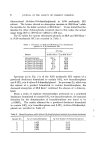
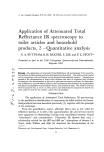
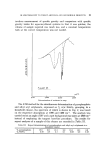
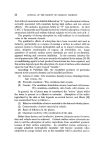
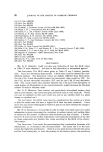
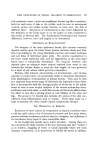
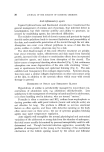
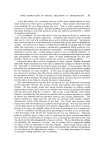
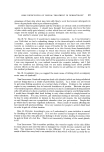
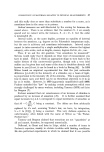
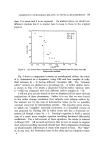
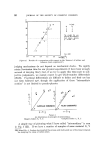
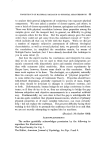
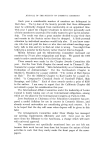
CONSISTENCY OF MATERIALS RELATED TO PHYSICAL MEASUREMENTS 51 time, S is stress and k is an exponent. (In modern times, we should use different symbols but it is simpler here to keep to those in the original papers.) 100 a ot•i•c. •t--I ,. 80 • • • t ,, .• ,, • t• r ,, 60 ß • 40 •o 0 ' ' ' "'"J ' • ....... J .... J .... •---•--,rd -,• .... , 6'0 6'2 6'4 O-O 6'8 7'0 7'2 7'• 10g•e •/t Ak Figur• 3. The dotted lines represent the curves obtained from the data from the compression machine. Fig. 3 shows a comparison between an unvulcanized rubber, the value of k, determined on a rheometer, being 0.50 and four samples of truly fluid bitumen (k = 1) having different viscosities (18). The "bitumen softer" answers are plotted as a percentage (p). A rather similar curve is shown in Fig. 4 in which a plasticine-Vaseline-rubber mixture with k = 0.22 was compared with four different rubber samples (k = 0). I will not give you the details of how we dismissed all the more obvious explanations of these phenomena. Suffice it to say that we were forced to the rather strange conclusion that subjects were judging neither by the amount nor by the rate of deformation under (as far as possible) constant stress but by intermediate entities. The equation given above, to which our "complex" materials conformed, is a simplified version of one proposed by Nutting (19) in which stress also has a fractional ex- ponent (p) though p may be 1. Nutting's equation is itself a special case of a much more complex equation involving fractional differeritial coefficients. For a full account of these equations, the reader is referred to Harper (17). All we need say here is that we saw no reason to suppose that subjects handling materials should base their judgements of firmness on whole-number differentials of strain with respect to time. The "time" is, in any case, the Newtonian time of the clock and our subjective time- o
Purchased for the exclusive use of nofirst nolast (unknown)
From: SCC Media Library & Resource Center (library.scconline.org)