62 JOURNAL OF THE SOCIETY OF COSMETIC CHEMISTS the growing activity in the field of lipid chemistry. The focus of interest in the series has shewn a gradual transition from fatty substances of vegetable origin or industrial significance to the function of lipids in biological systems. The present volume which continues that trend, may be of particular interest to cosmetic chemists concerned with the conditions of skin permeability. This account of progress in lipid chemistry deals with the specific function of phospholipids in relation to cell membranes. The work is divided into three broad topics, of which the first occupies half the text. Detailed treatment is given to the lipid composition of cell membranes, of specialized cells such as erythrocytes, and of sub-cellular particles, e.g. nuclei and chloroplasts. The chemical structure of phospholipids and their relation with cholesterol and the nature and significance of the non-polar side groups are discussed. It is generally agreed that the integral nature of cellular interfaces is due to a surface active function of phospholipids, i.e. by interaction with both lipid and protein structures. There is much more room for argument, however, when seeking to assign the nature and magnitude of the forces involved in associating and aligning the components of the membrane. Further, by no means all membranes appear to conform to the lipid "sandwich" model non-lamellar structures and multi-unit associations are not uncommon. Thus in the second section, current theories are elaborated for the molecular arrangement of lipids within biomembranes and as constituents of enzymes. Reference is made, with suitable illustrations, to powerful physical techniques (such as electron microscopy and X-ray diffraction) and micro- biophysical studies in relatively simple systems. A natural membrane is a metabolically dynamic system - phospholipids may assist in this fluidity by enzyme transport at the boundaries. The final section, therefore, gives a fairly brief account of some of these dynamic aspects of membrane phospholipids, notably their participation in several related synthetic and catabolic pathways and their importance in a variety of membrane transport processes. This survey emphasizes that research into the properties and composition of cell membranes should enhance our knowledge of the relation of structure and function of lipids within membranes. Nevertheless one must share the author's conclusion that in the vast field of interdisciplinary research on molecular architecture and functioning of biomembranes, many biological, chemical and physical problems with lipids still challenge the investigator. This is a slim and relatively expensive volume - it is well written and illustrated although the presentation remains very much for the specialist. Though nominally part of the Progress in Lipid Chemistry series, it may well be read in isolation by all concerned with cytochemistry. G.F. PHILLIPS.

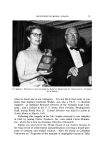
Society of Cosmetic Chemists Great Britain of 1965 SOIR•,E The Society's second Soirde was held on 9th October 1965 at the School of Pharmacy, London, when a number of members and friends spent a pleasantly informal evening together. During the course of the evening Diplomas were presented to several of the candidates who had been successful in the Society's 1965 Diploma Examinations. Miss Helen BirreI1, as prize-winning student of the year, was also awarded •5. The rest of the evening was taken up with dancing together with two diversions in the form of a smelling competition and a show of slides taken during the visit to the 1964 I.F.S.C.C. Congress in New York. SYMPOSIUM ON PHYSICAL METHODS The Symposium on Physical Methods which took place at Bristol on the 16th and 17th November was attended by 84 participants, including visitors from Belgium, Germany, South Africa, Sweden and Switzerland. On the afternoon of the 16th November, symposium participants visited the laboratories of the School of Pharmacy, Bristol College of Science and Technology, Ashley Down, by kind invitation of Professor D. A. Norton. During the evening of 16th November, participants attended a Civic Reception at the Council House, given by the Lord Mayor of Bristol,. Alderman T. H. Martin, M.B.E. 63
Purchased for the exclusive use of nofirst nolast (unknown)
From: SCC Media Library & Resource Center (library.scconline.org)