48 JOURNAL OF THE SOCIETY OF COSMETIC CHEMISTS to test his modification of Fechner's "law." It is, in fact, possible to persuade subjects to judge a stimulus as being twice as great or half as great as a control stimulus and so to calculate Fechner's "constant." Meanwhile Plateau, a fellow-countryman of Delboeuf's, proposed a double logarithmic (power) relation to replace the single logarithm of Fechner, though he later repudiated the idea. (The power relation may have been proposed independently by Brentano.) I tell this brief story because it has a striking counterpart at the present time and the close parallelism with the earlier controversies appears to have been missed. Stevens (8) described many experiments and concluded that, for most (but not all) stimuli, the double logarithmic law is valid. Recently, however, Treisman (9-11) has criticized Stevens on the grounds that no experimental device can distinguish between the two equations. One cannot regard the responses of subjects as scientific observations. Dr. Treisman has kindly explained his ideas personally to me and it seems to me that, fundamentally, his objections differ little from those of Tannery (12)*. Stevens (13) has very naturally replied on much the same lines as did Delboeuf, that his 'equations are derived from experi- mental data and are not artefacts. The debate continues! Meanwhile, whether sensations are truly measurable quantities or not, we can certainly record what people say that they feel. In a lighter vein: There once was a craftsman of Deal Who judged all his products by "feel" But he spent his brief leisure In trying to measure Sensations he knew were not real. Seriously, however, in all the traditional industries, which certainly include cosmetics and dairying (and even some of the new industries) the craftsman still judges the consistency of his materials and products by "feel" and it is the business of the physicist (rheologist) to try to design instruments which will give measures at least on an interval scale to supplement the craftsman's ordinal assessments. I particularly stress "supplement" because I think it no more likely that such instruments will replace the craftsman than that the clinical thermometer and the sphygmomanometer will replace the family doctor. Yet no "G.P." would be without these instruments today. I first came across this problem in the bread-making industry and realized that the rheologist cannot deal with such matters alone. I had the good fortune to have the late Professor *Bergson's criticism was rather different. He believed that measurable quantities must be able to be simultaneously present "in space." Stimuli can be so present but sensations cannot. This is not Treisman's point.

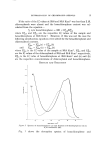
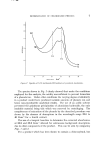
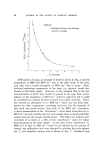
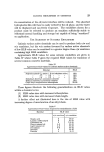
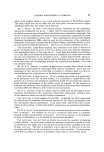
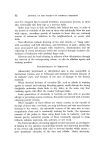
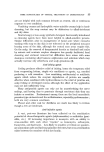
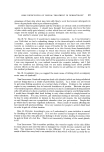
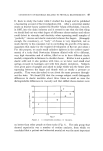
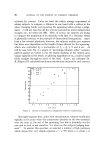
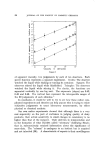
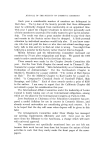
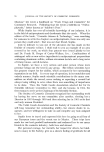
CONSISTENCY OF MATERIALS RELATED TO PHYSICAL MEASUREMENTS 49 D. Katz to study the baker while I studied the dough and he published a fascinating account of his invest. igations (14). After a somewhat similar study on heather honey (assisted by Brother Adam of Buckfast), I moved, in 1937, into the dairy industry and it seemed to me that the first thing we should find out was what degree of difference cheese-makers and others could detect in viscosity and elasticity when squeezing small samples of "perfectly" viscous and elastic materials between the fingers. (Strangely enough, the consistency, or "body" of cheese is very important, not so much directly to the consumer, but in controlling the growth of the micro- organisms that make for the required development of flavour and odour.) For this purpose, we made small cylinders (spheres in the earliest experi- ments) of a truly fluid Newtonian bitumen diluted with oil to different, very high viscosities and of rubber, filled so as to have different elastic moduli, comparable in firmness to cheddar cheese. Rubber is not a perfect elastic solid and it also perishes with time, so we later used small steel springs encased in bandages and with firm plastic end-pieces. Subjects were given pairs of samples and asked to judge which was the firmer after squeezing between the finger and thumb with as steady a pressure as possible. They were also asked to use about the same pressures through- out the tests. We found (15) that the average subject could distinguish differences in elastic modulus about three times as small as were the distinguishable differences in viscosity and that skilled cheese-makers were lO0 8o .a x o • 60 • 40 0 0.5 1.0 log A Figure 1. X compression modulus' ¸ viscosity. 1.5 no better than other people at these tasks (Fig. 1). The only group that showed superiority was a number of routine analysts, from which we concluded that a patient and unhurried mental set was the most important
Purchased for the exclusive use of nofirst nolast (unknown)
From: SCC Media Library & Resource Center (library.scconline.org)