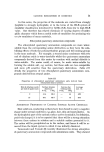
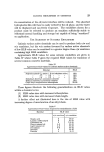
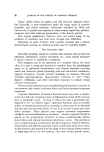
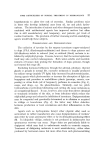
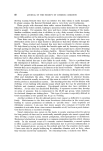
CATIONIC EMULSIFIERS IN COSMETICS 23 its concentration at the oil/water interface will be reduced. The adsorbed hydrophobic film will then be easily wetted by the oil phase, and the water will be displaced and can freely evaporate. The emulsifiers chosen for a product must be selected to produce an emulsion sufficiently stable to withstand normal handling and storage but capable of being "sensitized" on application. THE SELECTION OF SUITABLE EMULSIFIERS Cationic surface active chemicals can be used to produce both o/w and w/o emulsions, but the w/o system favoured by surface active chemicals of low HLB value can be sensitized to a greater degree than o/w emulsions containing high HLB emulsifiers. Approximate HLB values for some cationic emulsifiers are given in Table IV whilst Table V gives the required HLB values for emulsions of several common cosmetic materials. Table IV Approximate HLB values for cationic surface active ',hemicals Material HLB Polyethoxylated C•2 amine ( 5 mol ethylene oxide) ,, C•2 ,,. (15 ...... C•s ,, (15 ...... Didodec'•rl dimethyl ammonium chloride Dodecyl trimethyl ammonium chloride Cetyl ethyl morpholinium ethosulphate 13'0 15.3 16.7 10.0 15'0 25-3O These figures illustrate the following generalizations on HLB values within a chemical series {1) HLB value rises with increased ethoxylation. {2) HLB value rises with increased chain length. A further effect not illustrated here is the rise of HLB value with increasing degree of unsaturation of an alkyl chain. Tal •le V Approximate HLB values re( uired for emulsification (7,16) Material HLB value w/o emulsion o/w emulsion Stearic acid Lanolin (USP anhyd) Cottonseed oil Heavy mineral oil Light mineral oil Petrolatum Beeswax Paraffin 6 8 5 4-5 4-5 4-5 4 4 15-17 10-15 7.5-10 10-12 10-12 10-12 10-16 9-11

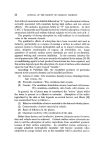
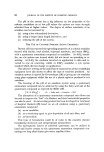
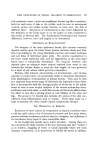
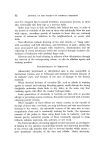
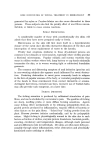
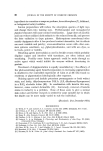
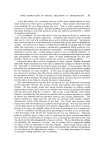
JOURNAL OF THE SOCIETY OF COSMETIC CHEMISTS The pH of the system has a biõ influence on the properties of the cationic emulsifiers as at low pH values the cations are more strongly adsorbed than at higher values. The deõree of surface sensitivity of an emulsion can be increased by (a) using a less ethoxylated derivative, (b) usinõ a longer chain length derivative, and (c) reducing the pH of the system. THE USE OF CATIONIC SURFACE ACTIVE CHEMICALS Burton (17) has reported the spreading properties of a cationic emulsion formed with lanolin, cetyl alcohol, isopropyl myristate, and water (50%), with a quaternary ammonium compound as emulsifier. At 4.0% emulsi- fier, an o/w system was formed which did not invert on spreading or re- wettinõ. At 0.4% the emulsion inverted on application to skin and re- verted to o/w on rewettinõ, whilst at 0.04ø,/o emulsifier a w/o system resulted which did not change on application. The selective wetting of the materials of construction of the emulsifyinõ equipment have also shown to affect the type of emulsion produced. An emulsion system is quoted by Dvoretskaya (18) as giving an o/w emulsion using glass equipment whilst the use of a plastic aõitator produced a w/o emulsion. The lowering of the pH of an emulsion system usinõ a quaternary ammonium compound can be achieved by usinõ the fatty acid salt of the quaternary compound as reported by Hilfer (19). I R' N (CH8)8] + C1- + fatty acid -• Complex + I-IC1 The adsorption of a quaternary ammonium compound onto fibres can be used to improve the "feel" of a blanket, and their bactericidal properties can also be used. An interesting product has been developed for treatment of hospital blankets (20) based on an oil emulsion using a quaternary ammonium compound (a) as an emulsifier, (b) as a sensitizing agent to give deposition of oil onto fibre, and (c) as bactericide. This type of formulation could be of value to the cosmetic chemist formulating deodorant and antiperspirant preparations. The hydrophobic barrier of adsorbed quaternary can be utilized in hand and barrier creams as the quaternary ammonium compounds con- taining two long alkyl chains give water repellent films.
Purchased for the exclusive use of nofirst nolast (unknown)
From: SCC Media Library & Resource Center (library.scconline.org)