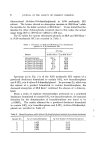
CATIONIC EMULSIFIERS IN COSMETICS 21 In this series, the properties of the molecule are varied from strongly lyophilic to strongly hydrophilic, or in the terms of the HLB system of emulsifier classification introduced by Griffin (7,8), from low to high HLB value. One therefore has related chemicals of varying degrees of hydro- philic character which form a useful series of emulsifiers for producing w/o or o/w emulsions of many materials. Ethoxylated quaternary ammonium compounds The ethoxylated quaternary ammonium compounds are more water- soluble than the corresponding amine derivatives as they have the solu- bilizing effects of both the polyoxyethylene groups and the ionizing groups in the same molecule. For example, a stearyl amine condensate with two mol of ethylene oxide is water-insoluble whilst the quaternary ammonium compounds derived from this amine by reaction with methyl chloride is water-soluble. The amine could, of course, be made water-soluble by forming the soluble salt, e.g. acetate, but these salts are less compatible and more pH sensitive than the quaternary derivatives. Table III details the properties of two ethoxylated quaternary ammonium com- pounds derived from stearyl amine. Table III Properties of ethoxylated quaternary ammonium salts derived from ethoxylated stearyl amines. Mol of ethylene oxide Surface tension Canvas disc Average per tool of quaternary dynes/era wetting time tool. wt. 0.1% 1.0% 0.1% 1.0% 2 41.4 38.3 -- 44 422 15 49.1 48.7 -- 73 994 ADSORPTION PROPERTIES OF CATIONIC SURFACE ACTIVE CHEMICALS Most solid non-conducting surfaces have been found to carry a negative charge under normal conditions, e.g. glass, hair, skin and most plastics. As the hydrophobic part of the cationic surface active chemical is, by definition, positively charged, it is to be expected that there will be a strong attraction between these cations in solution and a suitable surface presented to it. The cation will be precipitated on to the surface, and hence it will be re- moved from the liquid system in which it was initially dissolved. Tamamushi and Tomaki (9) recently illustrated the strong adsorption of quaternary ammonium compounds onto aluminium oxide. They showed

22 JOURNAL OF THE SOCIETY OF COSMETIC CHEMISTS that dodecyl ammonium chloride followed an "L" type adsorption isotherm, normally associated with materiMs having high surface and low solvent affinity. The anionics, in general, follow an "S" type isotherm. At their C.M.C.'s Tamamushi and Tomaki showed the relative adsorption of dodecyl ammonium chloride and sodium dodecyl sulphate to be in the ratio of 8: 1. The property of strong adsorption by solid surfaces is of considerable value to the cosmetic chemist. The qualitative effects of adsorption have been recorded and used in industry, particularly as a means of causing a surface in contact with an aqueous system to become hydrophobic and so to impart corrosion resis- tance, dropwise condensation of vapour, oil wettability, etc. Large quantities of cationic surface active chemicals are used in ore flotation, pigment wetting and corrosion inhibition. In the cosmetic industry the use of quaternaries (10), and more recently ethoxylated fatty amines (11-15) as conditioning agents in hair product formulations has been reported, and this action depends upon the adsorption of a layer of surface active chemical upon the hair fibre to give it good "handle." According to Pickthall (14), the emulsified products of particular interest to the cosmetic chemist can be classified as follows: (1) Lotions or milks: O/w emulsions-beauty creams, cleansing lotions, hair creams, etc. (2) Pourable emulsions: W/o emulsions-hair creams. ($) Creams: O/w emulsions-foundation creams, hand and cold creams. W/o emulsions-emollients, skin foods, cold creams, etc. In general, the oil phase may be considered the "active" phase whilst the water is present as a diluent or extender. Adsorption of the active ingredient by the skin or hair depends on several factors, and Blank (15) has summarized these as follows:m (1) Relative solubilities of active materiM in the skin and vehicle phases. (2) Concentration of active material in vehicle. ($) Rates of diffusion in the phases. (4) Chemical reactivity with constituents of the skin. Before these factors can be effective, however, intimate contact between skin and vehicle must be achieved. Cationic surface active chemicals are able to aid the adsorption of active ingredients from emulsified products because of their surface adsorption. An emulsified system containing a strongly adsorbed hydrophobic emulsifier will become unstable when subjected to a large surface area as the emulsifier will be adsorbed, and so
Purchased for the exclusive use of nofirst nolast (unknown)
From: SCC Media Library & Resource Center (library.scconline.org)