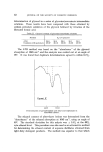
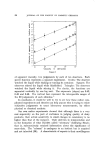
10 JOURNAL OF THE SOCIETY OF COSMETIC CHEMISTS nitrate ion in aqueous solutions. Such a determination was also reported by Katlafsky and Keller (5), who extended the technique to the deter- mination of the sulphate ion and 2-methyl-2-nitro-l-propanol in aqueous solutions. In this communication we wish to describe the application of ATR to the quantitative determination of relatively major components in various types of toilet articles and household products. EXPERIMENTAL The ATR spectra were recorded on a Unicam SP 200 IR spectrometer using a TR-3 ATR attachment, manufactured by Research and Industrial Instruments Co. An Irtran II prism was employed as the analysing crystal and the reference beam was attenuated to give an absorbance value of approximately 0.1 at a wavelength where the sample showed no absorption. Liquid samples were introduced with a syringe through the filler-ports into the cell formed by fitting the backing plate, with a Teflon seal, to the prism mount, care being taken to ensure that there were no air bubbles in the cell. Viscous liquids were poured on to the back face of the prism, held in a horizontal position, and the backing plate then clamped in position. In the case of soap samples, these were shredded on a cheese grater and a portion of ,the shredded samples pressed against the back face of the prism. For the preparation of calibration curves the ATR spectra of a series of standard samples (in most cases these were prepared by dilution of a reference concentrated sample) were recorded. The "absorbance" of the characteristic peak was measured, using a tangent base-line, for each standard and plotted against the % w/w concentration of the component. For the analysis of a sample, the ATR spectrum was recorded on the sample "as is" by a similar procedure to that used to prepare the appro- priate calibration curve. RESULTS AND DISCUSSION The angle selected for each analysis was that which gave the greatest absorbance value but still produced absorption peaks which did not appear distorted. It varied for each type of sample but was within the range 33 to 40 ø. To eliminate any possible backlash in the ATR attachment the angle setting was always made by approaching from low angle side. For most liquid samples a linear calibration curve of "absorbance"

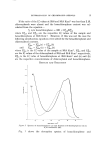
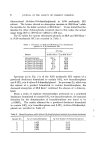
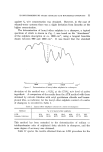
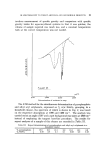
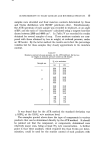
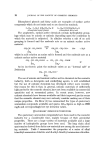
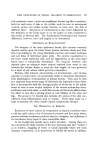
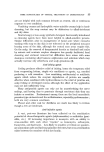
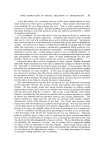
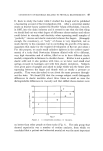
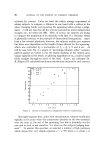
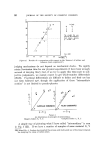
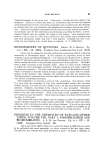
IR SPECTROSCOPY TO TOILET ARTICLES AND HOUSEHOLD PRODUCTS 11 against % w/w concentration was obtained. However, in the case of ethanol-water systems there was a slight deviation from linearity at the higher concentration. The determination of lauryl ether sulphate in a shampoo, a typical spectrum of which is shown in Fig. 1, was based on the "absorbance" of the sulphate absorption at ca. 1220 cm -•, using a tangent base-line drawn between 990 and 1330 cm -•. It was found that the standard I I i I I /.400 I ,Zoo I 0oo C,•-- I Fig,tre 1. Determination of lauryl ether sulphate in a shampoo. deviation of the method was q-0.2% at the 17.0% w/w level of active ingredient. A comparison of the results from the ATR method with those obtained by cationic titration with cetyl pyridinium chloride and bromo- phenol blue, as indicator, for the lauryl ether sulphate content of a series of shampoos is recorded in Table I. Table I Lauryl ether sulphate content of a series of shampoos Method % w/w lauryl ether sulphate ATR 16.4 19.0 16.8 16.6 16.8 17.2 19.1 Cationic titration 16.26 19.05 16.71 16.67 16.95 17.11 19.0 This method has been extended to the determination of sodium or triethanolamine salts of sulphated fatty alcohols in shampoos, and the same degree of accuracy was obtained. Table II quotes the results obtained from an ATR procedure for the
Purchased for the exclusive use of nofirst nolast (unknown)
From: SCC Media Library & Resource Center (library.scconline.org)