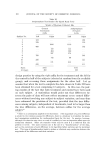
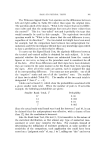
134 JOURNAL OF THE SOCIETY OF COSMETIC CHEMISTS the greatest single source of error both by preventing a thorough mixing of the two emulsifiers in the water phase, and by coloring the oil-layer prematurely. For this reason, the method calls for titrating a higher HLB with a lower one, and does not offer the alternate choice. It is possible in some systems, especially in preliminary screening runs, to pass through the optimum HLB for forming an O/W emulsion with the oil phase. While this is not the titration end point, it is still an analytical nuisance. Continuing the titration should be attempted, and eventually the emulsion should break up. In the case of lauryl alcohol, however, the emulsion may be a quite compact mass and form more or less of a plug at the top. In case of difficulty, two alternatives are offered. First, one can start all over again, using a different substrate to begin with, having an HLB below the value of 14 published as optimum for the O/W emulsifi- cation of lauryl alcohol. Or, one can set up a series of step-wise titra- tions in which both the high and the low HLB solutions are premixed in the cylinders and brought up to volume before the lauryl alcohol is added. Now, observations after shaking can be lined up, and the titra- tion HLB closely estimated. This alternative is reminiscent of the mak- ing of an emulsion series to determine HLB values, but it is far faster. Each phase separation will be complete enough to be evaluated in under five minutes, even if the entire 10 ml of oil does not separate out in that time. To determine the HLB of an unknown emulsifier, a simple oil of known HLB requirement is selected, and titration is performed with so- lutions of the unknown surfactant and one of known HLB. Another common problem is to determine the proper O/W emulsification HLB requirement of a mixed oil phase that has already been selected. The author usually starts a trial with solutions of emulsifiers with extremes of HLB. Thus, a range for the end point is found quickly. This can be further refined by repeating the titration with two surfactants both somewhat closer to this range. One difficulty with this method is the evident requirement that the oil phase must be liquid at room temperature, so that the carbon can distribute, and so that the oil phase can separate out homogeneously. Bearing in mind that not only are the HLB's of emulsifiers additive in mixtures, but that the same holds true for oil-phase HLB requirements, the author has worked with toluene solutions of petrolatum. It appears that the additive function works very well so long as the petrolatum re- mains dissolved that is, as long as the concentration is below that of a

DETERMINATION OF HLB 135 saturated solution. HLB's of these mixtures titrated with increasing accuracy as the content of petrolatum was increased. EFFECTS OF OTHER FACTORS The effects of added electrolyte, alcohol, and increased temperature are of minor influence when relatively small changes are made in these parameters. Above certain levels, the effects become so large that the author has not yet been able to measure them completely with accept- able accuracy. Up to 1% electrolyte in the titration is tolerable, whether acetic acid, sodium or potassium chloride, or aluminum salts, so long as no chemical reaction occurs in the system. Up to about 10% alcohol, ei- ther ethyl or isopropyl, can also be accommodated. Temperatures to 35 øC induce little change. Above this, titration HLB's rise rapidly (considerably more of the low HLB titrant must be added) and duplica- tion of results becomes difficult. The fact that these three factors change the HLB of a system is of great interest. Those who develop emulsion products are aware that any one of these can destroy an otherwise elegant formulation. It is therefore suggested that titrations be performed after including the elec- trolyte or alcohol in the water phase. This may ease later efforts to as- sure stability. As to temperature, stable emulsions have been found to separate after oven storage. The change of HLB requirement reported here may be a sufficient explanation, although not a remedy. Possibly supplying an HLB intermediate between the two may offer stability at both oven and room-temperature conditions. These three factors most likely operate by changing the hydration of the ethylene oxide chains, thereby altering the micelle structure and critical micelie concentration of the system. The method has other built-in bonuses, which can be used with in- genuity to solve many difficult cases, sometimes almost accidentally. The author had occasion recently to emulsify a very dark colored oily material. Obviously, a prior determination of the HLB was desirable. While dubious that any darkening of the oil from the carbon migration would be observable, the titration was tried anyway. To observe the darkening was, indeed, hopeless. But, rewardingly, at one point the water phase suddenly became almost white as the carbon transferred into the oil, not only demonstrating the end point, but also greatly relieving one anxious chemist. The HLB determined was, actually, quite cor-
Purchased for the exclusive use of nofirst nolast (unknown)
From: SCC Media Library & Resource Center (library.scconline.org)