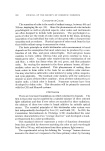
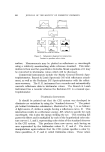
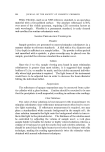
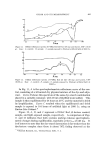
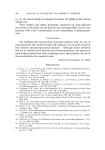
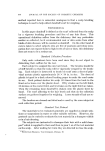
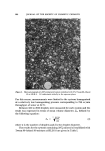
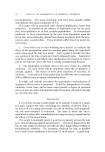
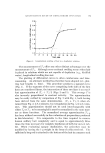
658 JOURNAL OF THE SOCIETY OF COSMETIC CHEMISTS SPECULAR INSERT '•'-•----.._••GHT SOURCE REFLECTANCE -----,,,•f --lt SAMPLE /• .... T•NS•SSION ZEROING SLIT SPLIT LENS •'• ROTATING "FLICKER" MmmO• , •, ,,,,• • , STOP • t PHOTOMULTIPLIER I I REFLECTANCE STANDARD DIRECT LICHT STOPS STRAY LIGHT STOPS TP•NSMISSION STANDARD - MICROMETRIC SLIT (VERTICAL ApERATURE) . TRISTIMULUS and ABRIDGED SPE CTROPHOTOME TER FILTERS Figure 8. Block diagram of the I.D.L. Color-Eye torized color measurement circuit. The readout is presented in X, ¾, Z tristimulus values as well as L, a, b scales (20) which closely correlate with the Munsell system. The L measures lightness or value, whereas the a and b readings represent chromaticity coordinates. A computer may be purchased with the instrument to give direct color difference measurements in NBS units. The Hunterlab Color Difference Meter does not offer the 10 or 16 wavelength spectrophotometric points offered in the Color-Eye, which are useful where nonmetameric matches are re- quired. The Hunter colorimeter may, however, be used in combina- tion with a Beckman DU or other diffuse reflectance spectrophotometer if nonmetameric matches are required and may be applied to routine control of pharmaceutical color formulations. Another commercial instrument, called the Davidson and Hemmend- inger Colorant Mixture Computer (COMIC), enables the colorist to measure reflected light from a sample of various wavelengths, using K/S

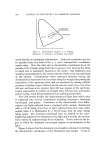
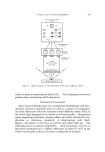
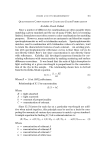
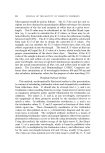
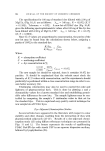
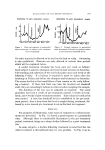
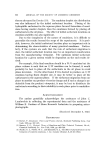
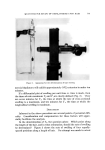
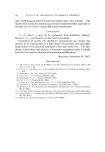
COLOR AND ITS MEASUREMENT (359 Figure 9. COLOR-MEASUREMENT CIRCUIT .¸. ¸ ¸ a -b L• L _ TRISTIMU LUS FILTEI•S CLEAR METHACRYLATE LITE PIPE Block diagram of the Hunterlab D-25 Color Difference Meter values to make a nonmetameric match (21). The techniques involved to perform these calculations will be discussed. REFERENCE STANDARDS Since most tristimulus data are a comparison of luminosity and chro- maticity, reference standards must be used as a means of comparison. An ideal reflectance reference standard would diffusely reflect 100% of the visible light impinged on its surface at all wavelengths. Magnesium oxide, magnesium carbonate, barium sulfate, and white vitrolite have ap- plication as reflectance standards. A disadvantage with MgO, MgCOa, and BaSO4 is that they are brittle and yellow with age. The yellowing process is slowest with BaSO4. Their advantage, however, is that these standards have a diffuse reflectance of about 97-99% in the visible wavelengths, makinx reflectance reading almost absolute.
Purchased for the exclusive use of nofirst nolast (unknown)
From: SCC Media Library & Resource Center (library.scconline.org)