660 JOURNAL OF THE SOCIETY OF COSMETIC CHEMISTS White Vitrolite, used as an NBS reference standard, is an opal glass material with a fire-polished surface. The absolute reflectance is 90% over most of the visible spectrum, requiring CIE correction factors at each wavelength. Vitrolite is a permanent standard, is easily cleaned and excellent for routine colorimetric work. SAMPLE PREPARATION TECHNIQUES Powders Sample powders are presented to most tristimulus colorimeters in a manner similar to reference standards. A dish with a 4 in. diameter and •/•-in. depth is sufficient as a sample holder. The powder is often packed and smoothed with a spatula a glass coverslip may be placed over the sample, provided the reference standard has a similar cover. Tablets Since the 2- to 4-in. sample viewing area found in most tristimulus colorimeters is greater than most tablets, it is suggested that sample holders of • in. or smaller be made, and the tablets measured individu- ally where high precision is required. The light beam of the instrument would have to be adjusted here in order to decrease the beam diameter hitting the individual tablet. Suspensions The reflectance of opaque suspensions may be measured from a plas- tic cylinder with a glass bottom. Caution should be exercised to be sure that the precipitate is well suspended, resulting in uniform color readings. Clear Solutions The color of clear solutions is best measured with transmittance tri- stimulus colorimetry since reflectance measurements often lead to exces- sive light scattering. If reflectance measurement is required, one may place a standardized white ceramic background in the sample cell the clear solution transmits the light onto the background which in turn re- flects this light to the photodetector. The thickness of the solution must be controlled by adjusting the volume of sample used a 5-ml glass sample holder is feasible for darker or highly colored solutions whereas a volume of 10 ml may be used for nearly clear and colorless solutions. It should be noted that the light beams travel twice the distance with this technique, making the reading approximately twice the stimulus values obtained with normal reflectance techniques.

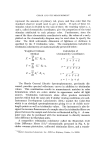
COLOR AND ITS MEASUREMENT 661 QUANTITATIVE COMPUTATION OF COLOR AND COLOR FORMULATION Kubelka-Munk Method Since a number of different dye combinations are often possible when matching a given standard and the use of many FD&C dyes is becoming limited, formulators must often resort to color combinations for matching purposes. However, many matches are metameric and therefore require spectrophotometric as well as tristimulus analysis. Spectrophotometric matches, used in combination with tristimulus values of a mixture, tend to retain the characteristic features of each colorant. An existing prob- lem with spectrophotometric reflectance curves is that these curves do not directly follow Beer's law since concentration is not directly linear with reflectance. Kubelka (22) developed numerous formulas for cor- relating reflectance with concentration by making scattering and surface difference corrections. It was found that the ratio of light absorption to light scattering at a given wavelength is proportional to the concentra- tion of the dye in the sample. The relationship shown here is derived from the Kubelka-Munk equation. (• - •)• (•) Where R = 1.0 at 100% reflectance. Relationship of K/S to concentration K/$ = kc (2) Where K = light absorbed S = light scattered k = constant of proportionality C = concentration of colorant Since K/S factors for each dye at a particular wavelength are addi- tive when mixed together, this principle may be used as a basis for com- puting the amounts of various dyes necessary to match a given standard. A sample equation for finding K/S of a colorant mixture is: (K/$),•x. = a(K/S)A + b(K/$)• + c(r/$)c + ...w(K/X)wh•e •se (3) Where a = concentration of colorant A b = concentration of colorant B c = concentration of colorant C w = concentration of white base
Purchased for the exclusive use of nofirst nolast (unknown)
From: SCC Media Library & Resource Center (library.scconline.org)