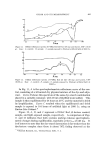
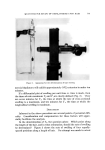
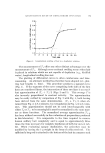
7O6 JOURNAL OF THE SOCIETY OF COSMETIC CHEMISTS that it will hang parallel to it and also extend above the solution. The depth of the rod in the solution may then be monitored either optically or through use of a linear voltage differential transformer. CONCLUSION T,, Tf,, and T•,/z• may all be correlated with depilatory efficacy. However, Tj,/D was found to be the most convenient. Evaluation of nearly 500 depilatory preparations has shown this method to be reproducible to a high degree of precision and essentially independent of the physical condition of the hair under test. The sim- plicity of procedure and paucity of necessary equipment make it ideally suited for t he rapid evaluation of formulation modifications. (Received November 20, 1967) (•0) (1l) (12) REFERENCES (1) The Papyrus Ebers, trans. by B. Ebbell, Vol. 63, Copenhagen and London, 1937, p. 76 Ibid., Vol. 67, p. 80. (2) Hiss, A. E., and Elbert, A. E., New Standard Formulary, G. P. Engelhard, Chicago, 1910, p. 1001. (3) Weinhold, P.M., Brit. Patent 478,176 (1938). (4) Lucas, II. V., U.S. Patent 2,067,909 (1937). (5) Gemsback, H., U.S. Patent 1,620,$39 (1927). (6) Perl, J., U. S. Patent 450,032 (1891). (7) Evans, R. L., and McDonough, E.G., U.S. Patent 2,3•2,•24 (1944). (8) Alexander, P., Review of progress in cosmetics, Specialties, 16• $ (1965). (9) Walker, G. T., The chemistry and formulation of depilatories, Am. Perfumer Cosmetics, 77, 86 (1962). Schimmel Britfs, Cosmetic formulations from the patent literature, H340 (July 1963)., Rousell Labs Ltd., Calcium thioglyeollate as dipilating agent, Soap, Perfumery Cosmetics, 31, 799 (1955). Bull, K. B., Chemical depilatories, Ibid., 31• 63 (1965).
Purchased for the exclusive use of nofirst nolast (unknown)
From: SCC Media Library & Resource Center (library.scconline.org)