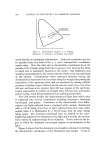
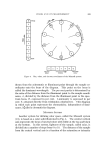
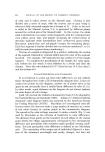
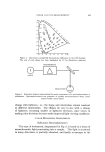
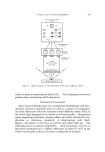
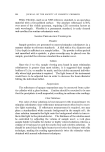
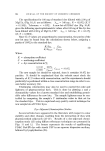
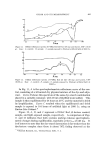
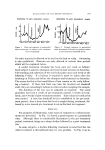
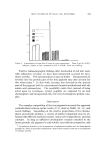
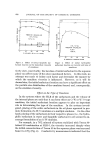
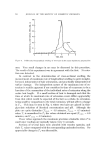
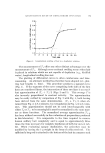
EFFECT OF SURFACTANT LOCATION ON EMULSIONS 689 •--W/O •[• O/W = ( 5 % TOTAL) • • TWEEN 80 - ARLACEL 80 / HLB I0 / • 70ø/001L ./ -- 20 40 60 80 •00 % TWEEN 80 IN AQUEOUS PHASE Figure 5. Effect of initial hydrophilic sur- factant location on viscosity and type of emulsions 8 o/w w/o •= SOLULAN 98 - AMERCHOL L-IOI ( 5% TOTAL) ß HLB I0 60% OIL 0 20 40 60 BO I00 % SOLULAN 98 IN AQUEOUS PHASE Figure 6. Effect of initial hydrophilie sur- factant location on viscosity and type of emulsions sharp increase in the emulsion viscosity was due to phase inversion from W/O type to O/W type. Figure 5 shows the viscosity change for a similar system at HLB 10. In this system, the inversion took place when the amount of Tween 80 initially in the aqueous phase corresponded to approximately 70% of the total Tween 80 used. Figure 6 shows a similar curve for a Solulan 98- Amerchol L-101 system. In these three systems the viscosity readings were taken with the No. 3 spindle at 30 rpm. It has been known that the type of surfactants as well as their con- centration have marked effect on the type of emulsion formed (8, 9). The present work indicates that not only the surfactant type and concen- tration are important, but the initial distribution of the hydrophilic sur- factant prior to emulsification can also have a significant effect on the type of the emulsion formed. Davies reasoned that the type of emulsion formed as the result of shaking of •a mixture of oil and water with an emulsifying agent is deter- mined by the relative coalescence rates (10). He suggested that: Rate 2 O/W emulsion preferentially stable if Rate• 1 and, Rate 2 W/O emulsion preferentially stable if --- 1 Rate 1

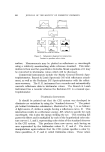
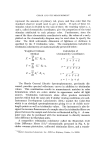
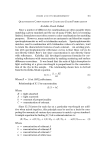
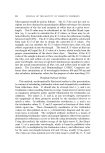
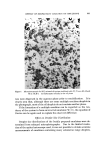
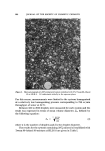
090 JOURNAL OF THE SOCIETY OF COSMETIC CHEMISTS where: Rate 1 = coalescence rate of an O/W emulsion Rate 2 = coalescence rate of a W/O emulsion From thermodynamic considerations, Davies further suggested that the ratio of coalescence rates could be related to the HLB value of the surfaetant and also to the partition coefficient of the surfaetant by the fol- lowing equation: CiRate 2 (c,,'• ø'7•ø C2 Rate 1 - \•/ (1) where: C• = collision factor for Rate 1 C2 = collision factor for Rate 2 c• = surfactant concentration in water Co = surfactant concentration in oil 0 = fraction of interface covered This equation qualitatively agrees with Bancroft's rule that the phase in which the emulsifying agent is more soluble will be the continuous phase (11). If Co and c• can be considered as the initial surfactant concentrations in each phase, it can be shown that the above equation also qualitatively explains the results of the present work. For example, the data presented in Fig. 5 indicate that when the c• is small (or Co is large) the system will form a W/O emulsion. Examination of the above equation would also indicate that reduction of c,,,/Co ratio would favor a W/O emulsion. In some systems studied which had relatively low HLB values, multiple emulsions were observed under the microscope. An example of such a system at HLB 6 is shown in Fig. 7. A conductivity measure- ment indicated that the continuous phase of this emulsion was water. As can be seen from the photograph, most of the oil droplets contain some very small water particles and the result is a (W/O)/W type emul- sion. Interestingly, the initial surfactant locations were also found to in- fluence the formation of such an emulsion. The emulsion shown in Fig. 7 was prepared by initially placing all the surfactants in the oil phase. Figure 8 shows a microphotograph of an identical system stabilized with Tween 80-Arlacel 80 at HLB 6. The only difference between this emul- sion and the previous one is the fact that all the surfactants in this sys-
Purchased for the exclusive use of nofirst nolast (unknown)
From: SCC Media Library & Resource Center (library.scconline.org)