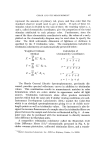
662 JOURNAL OF THE SOCIETY OF COSMETIC CHEMISTS This equation would be used as follows: The K/S for each dye and ex- cipient are first obtained by measuring the diffuse reflectance for a known concentration of the dye and excipient or white base at a given wave- length. This R value may be substituted in the Kubelka-Munk equa- tion (eq. 1), in order to calculate the K/S values, or these may be ob- tained directly from tables which give K/S values for reflectance reading between 0 and 100%. The K/S value of the diluent should be subtracted from each K/S of the dye to obtain the corrected K/S values. For example, one can calculate the K/S values of three dyes, blue, red, and yellow, separately at one wavelength. The total K/S values at that one wavelength will equal the K/S value of a brown, which results from the proper concentrations of the above three dyes. Therefore, if the value of the sample is known at three wavelengths and the K/S values of the blue, red, and yellow (at any concentration) are also known at the same wavelength, one may set up three simultaneous equations to calcu- late the actual concentrations of blue, red, and yellow used to make the match. The Davidson and Hemmendinger COMIC Computer per- forms these calculations at 16 wavelengths between 400 and 700 m/• and also calculates tristimulus values for the purpose of color matching (21). Weighted Ordinate Method This method, mathematically illustrated earlier in this presentation, is a means of calculating tristimulus values and chromaticity coordinates from reflectance data. It should also be stressed that x, y, and • are tristimulus values resulting from the average visual observer and are used as imaginary primaries under specific illumination for tristimulus cal- culations. The values X, Y, and Z, at any wavelength, correspond to the magnitude of these primaries needed by the standard observer to match a color. In addition, chromaticity coordinates, x, y, and z, are the tristimulus values X, Y, and Z expressed as fractions of their total, which equal one. These chromaticity coordinates of the tristimulus values are then plotted on an x, y chromaticity diagram and the spec- trum locus is located. The weighted ordinate method is a means of determining tristimulus values and sample lightness either from spectro- photometric reflectance curves or directly using tristimulus colorimetry. Using this method, the relative energy of the light source E c (for illumi- nant C) at a particular wavelength, which is found in published color tables (23), is multiplied by the tristimulus value •c and reflectance value for the same wavelength between 400 and 700 m/•, usually 10 m/• apart. The values are then summed over the total range to yield the X, Y, and

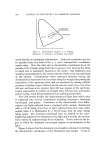
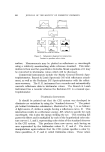
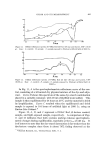
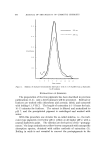
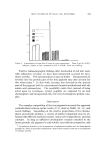
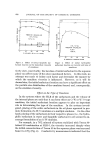
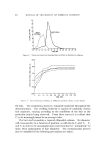
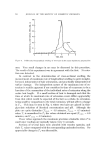
COLOR AND ITS MEASUREMENT 66 3 100 ' 80- 60- I I I 400 500 540 600 700 •mu Figure 10. Diffuse reflectance spectra of FD&C Red #3 Dye (100 mg) and light magnesium carbonate, USP (2.00 g). Key: A, standard dye spectrum: B, new sample lot spectrum Z tristimulus values. Chromaticity coordinates are then calculated by expressing the tristimulus values as fractions of their total values. The luminosity or lightness is determined directly from the Y tristimulus value expressed in per cent. Although there are other available methods for calculating tristimu- lus values (23), the weighted ordinate technique serves as a good means for deriving color values from diffuse reflectance measurements. I•HARMACEUTICAL APPLICATION Quality Control of FDiC Dyes The purity and quality of pharmaceutical dyes may be controlled, as illustrated with the following example: A manufacturer purchases a new lot of FD&C Red #3 dye. The predetermined standard spectrum of this dye compared to a MgCO3 reference standard is shown in Fig. 10 The spectrum for the standard dye is also diluted in a 1:20 ratio with MgCO3, since it is important that the color component be highly diluted with a relatively nonabsorbing diluent. This ensures a similar grain size for the dye and reference standard, causing the reference and sample scattering coefficients to cancel each other in comparison measurements. This facilitates scattering to be independent of wavelength (24).
Purchased for the exclusive use of nofirst nolast (unknown)
From: SCC Media Library & Resource Center (library.scconline.org)