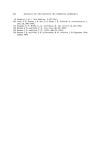
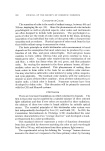
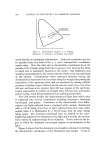
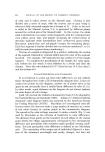
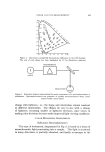
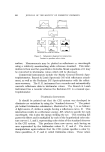
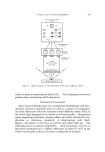
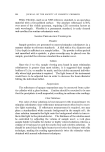
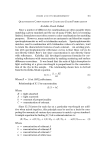
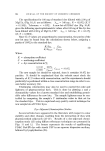
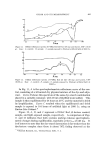
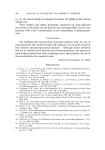
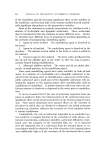
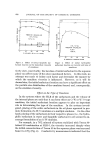
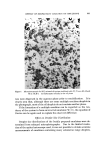
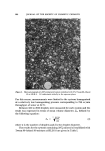
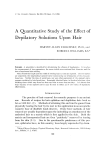
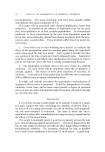
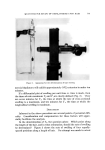
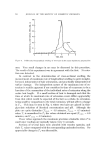
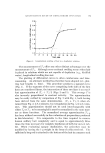
EFFECT OF SURFACTANT LOCATION ON EMULSIONS 687 I •THERMOMETER80ARLACEL80-TWEEN LEVEL - RBINE • IMPELLER 5" Figure 1. Emulsification vessel (5% TOTAL) o o I I I I 0 20 40 60 80 moo % TWEEN 80 IN AQUEOUS PHASE Figure 2. Effect of initial hydrophilic sur- factant location on the immediate viscosity of emulsions The emulsions obtained showed pseudoplastic behavior. Since the main interest was to determine the relative effects of the initial surfactant locations on emulsion viscosity, Brookfield viscometer readings on 100 scales were used rather than the absolute viscosity units. The viscom- eter readings were obtained with the No. 1 spindle at 30 rpm. As indicated in Fig. 2, for the emulsions having relatively low HLB values, the immediate viscosity following homogenization increases with the amount of Tween 80 initially present in the aqueous phase. As the HLB value increases beyond 8, this effect appears to become smaller and finally at HLB 14, the initial location of Tween 80 has no appreciable effect on the immediate viscosity of the emulsion. In Fig. 3, the systems studied were identical to the corresponding sys- tems given in Fig. 2. However, instead of varying Tween 80, the ratio of the lipophilic surfactant, Arlacel 80, in the oil phase and the aqueous phase was varied. All the hydrophilic surfactant was placed in the aqueous phase before emulsification. The data show that the effect of varying Arlacel 80 in the oil phase was not as pronounced as the effect of varying Tween 80 in the aqueous phase. And again, virtually no effect was observed in the high HLB systems. As pointed out by a number of authors ($-7), emulsion viscosity is a very complex function of the viscosity of the external phase, volume fraction of the dispersed phase, viscosity of the internal phase, particle size distribution, nature of the interfacial film, emulsifier concentration, the extent of flocculation, etc. If the rate of surfactant migration is rela-

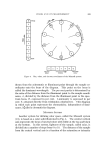
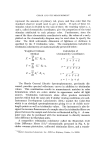
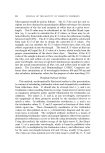
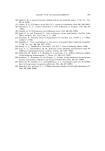
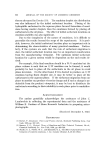
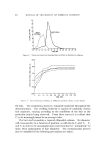
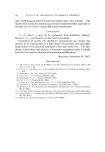
688 JOURNAL OF THE SOCIETY OF COSMETIC CHEMISTS TWEEN 80 - ARLACEL 80 ( õ% TOTAL) 30 % OIL HLB 12 - LB 14. 0 I I I I I 0 20 40 60 80 I00 % ARLACEL 80 IN OIL PHASE Figure 3. Effect of initial lipophilic sur- factant location on the immediate viscosity of emulsions w/o ,/ o/w ( 5% TOTAL) TWEEN 80- ARLACEL80 HLB 6 7'0% OIL o 2o ,,o ,o eo ,oo % TWEEN 80 IN AQUEOUS PHASE Figure 4. Effect of initial hydrophilic surfactant location on viscosity and type of emulsions tively slow, conceivably, the location of initial surfactant in the aqueous phase can affect many of the above mentioned factors. In this work, no attempt was made to isolate each factor and determine the manner by which the emulsion viscosity is influenced. However, as it will be shown later, the initial surfactant location can have a significant effect on the particle size distribution of the emulsion formed and, consequently, on the emulsion viscosity. Effect on the Type of Emulsion In the systems where the HLB of the surfactants and the volume of the internal phase are such that it can form either an O/W or W/O type emulsion, the initial surfactant location appears to play an important role in determining the type of the emulsion. In the systems investi- gated, placing of the entire surfactants in the oil phase appeared to pro- mote formation of a W/O emulsion or a multiple emulsion. On the other hand, placing of the surfactants in their respective phases (i.e., the hydro- philic surfactant in water and lipophilic surfactant in oil) seemed to en- courage formulation of an O/W emulsion. For example, in a 70% mineral oil system stabilized with Tween 80- Arlacel 80 combination at HLB 0, the viscosity increased sharply when the initial concentration of Tween 80 in the aqueous phase was increased from 0 to 10% (Fig. 4). Conductivity measurements indicated that the
Purchased for the exclusive use of nofirst nolast (unknown)
From: SCC Media Library & Resource Center (library.scconline.org)