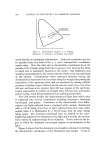
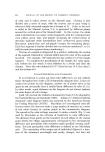
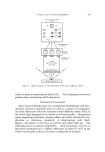
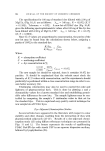
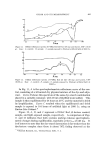
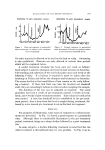
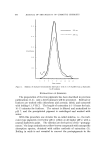
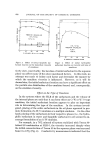
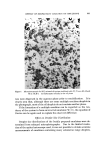
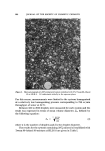
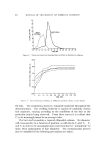
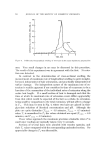
676 JOURNAL OF THE SOCIETY OF COSMETIC CHEMISTS 0.5 0.4 0.3 Absorbance 0.2 0.1 540 '80 mp. 1 3 5 7 9 11 13 15 17 Tube number Figure 1. Elution of dialyzed trichosiderin derivative with 0.1 N NaOH from a Sephadex G-50 column EXTRACTION OF SIDERINS The preparation of the iron pigments has been described in previous publications (2, 3) only a brief summary will be presented. Red hair or feathers are washed with chloroform and acetone, dried, and extracted with boiling 0.1 N HC1. The length of extraction is 1-3 hours for hair, 10-15 minutes for feathers. The extract is filtered and neutralized to pH 7, and the precipitated pigment is centrifuged and washed with water. With this procedure one obtains the so-called siderins, i.e., the indi- cator-type pigments (red below pH 2, yellow at all higher pH's) with a neutral isoelectric point. The siderins are derivatives of the "protopiõ- ments," the large nonindicator yellow-brown compounds with nonspecific absorption spectra, obtained with milder methods of extraction (3). Boiling in acids is not essential to convert the protopigments to the

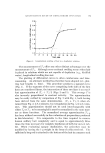
IRON PIGMENTS OF HAIR AND FEATHERS 677 siderins mere incubation of the acid protopigments of red feathers a 40øC effects the change to the red indicator pigment. Until now, little work has been done with the large-sized protopigments. The primary aim was to isolate the so-called chromophore, i.e., the smallest indicator-type unit with the typical absorption bands of the siderins. ISOL^T•OS OF rUE CHROMOPHORE The siderins have two types of groupings: an estimated 98% of their weight is an iron-poor (0.1-0.3% Fe) brown protein with a non- specific absorption spectrum (this component usually precipitates in acids) and about 2% of a relatively small, highly colored, indicator-like, nonprotein chromophore with an isoelectric point at about pH 4.3. The iron is firmly attached to the pigment. This composition is schemati- cally represented below: (Chromophore) Fe TM .... Protein In order to obtain the chromophore, the protein must be removed. This aim is achieved in several steps. First, KSCN (2% final concentra- tion) is added to acid solutions of siderins. Enough protein is precipi- tated by these procedures to render the chromophore combinations in the supernates dialyzable. The dialyzed product passes as a single band through a Septadex G-S0 column. Its two absorption bands in the visible and ultraviolet part of the spectra are in the same fractions (Fig. 1). The dialyzed pigment or the pigment obtained from siderins after splitting with KSCN splits in two fractions when passed through a Septadex G-25 column in 0.1 N NaOH: a more rapidly moving (hence larger molecular weight) broad brown band and a slowly moving narrow orange band which contains the chromophore. Repeated passage through Sephadex G-25 columns yields relatively pure, protein-free chromophores. A chromophore of high purity may also be obtained by precipitating at pH 4.3 the supernatant of the original siderin extract and then eluting this precipitate in a Septadex G-25 column with 0.1 N NaOH. It passes as a narrow orange band after the brown component. PROPERTIES OF THE PIGMENT COMPONENTS The protein part is a brown amorphous precipitate. Its amino acid composition revealed a low cystinc content (mostly traces), indicating
Purchased for the exclusive use of nofirst nolast (unknown)
From: SCC Media Library & Resource Center (library.scconline.org)