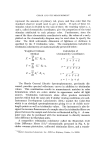
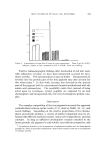
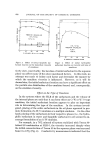
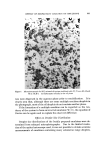
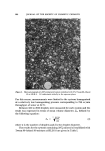
EFFECT OF SURFACTANT LOCATION ON EMULSIONS 69.5 permit generalization. However, it is evident that the initial surfactant distribution can have a significant effect on the stability of some systems. Davies discovered that HLB values of many surfactants could be cal- culated from the empirically determined structural group numbers (10, 15). He further suggested the following relationship between the coales- cence rates and HLB number: (C• Rate '•) = 2.20(HLB-7) (3) In • Rate Combining equations 1 and 3, an equation relating the HLB number to the partition coefficient of the surfactant can be obtained: (HLB-7) = 0.36 In (c•) (4) If the rate ooesurfactant migration is relatively slow, and if equation 4 is applicable, the surfactant mixture in an emulsified system can have different HLB values depending on the distribution of the constituent in the oil and water phases. Assuming that an emulsion having a maxi4 mum stability is obtained when the HLB value of the surfactant system equals that of the oil phase, it is clear that the initial surfactant location may be a significant factor affecting the emulsion stability. The HLB system developed by Griffin has been a very useful tool for emulsion chemists in spite of its limitations (16-18). The present work suggests that for the systems where the rate of surfactant migration is slow, it may be necessary to take this factor into account when determin- ing the HLB value by an empirical method. For example, a common practice of preparing an emulsion is to mix all emulsifiers into the oil phase before emulsification (19). Conceivably, for a certain system, determination of the required HLB value of the oil by such method may give a different value from that obtained by mixing all emulsifiers into the aqueous phase prior to emulsification. CONCLUSIONS Experimental studies using various nonionic surfactants indicated that the initial surfactant location could have significant effect on the physical properties of the emulsion produced. The emulsion viscosity immediately after homogenization was affected by the initial surfactant location although the effect appeared to diminish with the increase of the HLB number of the systems studied. Placing of the surfactants in the oil phase appeared to encourage the formation of a W/O emulsion or a multiple emulsion. The experimental results were consistent with the

090 JOURNAL OF THE SOCIETY OF COSMETIC CHEMISTS theory advanced by Davies (10). The emulsion droplet size distribution was also influenced by the initial surfactant location. Placing of the hydrophilic surfactant in the aqueous phase favored formation of emul- sions having smaller droplets than the emulsions formed by placing all surfactants in the oil phase. The effect of initial surfactant locations on emulsion stability was also significant. Due to the complexity of the nature of emulsions, it is difficult to generalize the results beyond the scope of the experiments. It is prob- able, however, the initial surfactant location plays an important role in determining the characteristics of many practical emulsions. Particu- larly, if the systems are such that the rate of surfactant migration is slow, the initial surfactant location may be an important consideration from the manufacturing viewpoint. The optimum initial surfactant location for a given system would be dependent on the end results de- sired. For example, if the final emulsion should be a W/O emulsion but the phase volume is such that an Of W emulsion can be formed, it would probably be best to place all the surfactants in the oil phase to avoid phase inversion. On the other hand, if it is desired to produce an O/W emulsion having finest droplet size, it may be better to place all the surfactants in the aqueous phase. If the surfactant migration from one phase to another can produce viscosity change and if such a change is un- desirable from the product viewpoint, it may be best to distribute the surfactants according to their solubility in each phase prior to emulsifica- tion. ACKNOWLEDGMENT The author gratefully acknowledges the assistance of John C. Lambrechts in collecting the experimental data and the assistance of William E. Gardner of Sloan Research Industries in preparing micro- photographs. (Received December 8, 1967) REFERENCES (1) Beeher, P., Emulsions: Theory and Practice, 2nd ed., Reinhold Publishing Corp., New York, 1965, pp. 267-325. (2) Sumner, C. G., Clayton's Theory of Emulsion and Their Technical Treatment, 5th ed., Chemical Publishing Co., New York, 1954, pp. 480-528. (3) Stanko, G. L., Fiedler, W. C., and Sperandio, G. J., The effect of physical factors on the formation of cosmetic emulsions, J. Soc. Cosmetic Chemists, 5, 29-50 (1954).
Purchased for the exclusive use of nofirst nolast (unknown)
From: SCC Media Library & Resource Center (library.scconline.org)