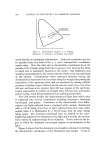
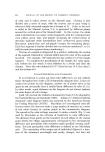
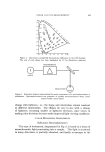
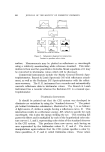
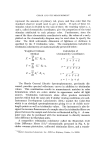
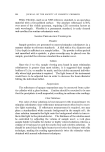
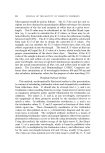
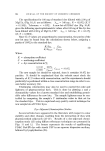
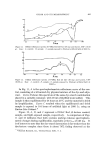
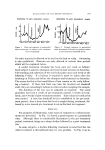
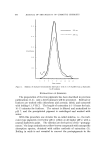
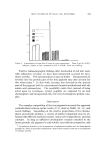
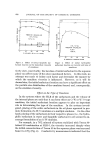
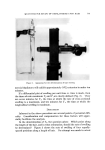
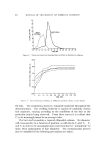
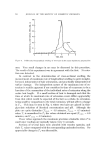
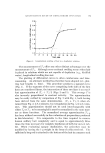
7O2 JOURNAL OF THE SOCIETY OF COSMETIC CHEMISTS Figure 2. CROSS SECTIONAL / / ! i _..•-,--'/[ 2 4 I0 12 14 16 IS 20 22 24 26 28 TIME, MIN. Cross-sectional and longitudinal swelling in depilatory solution .014 • .013 z _ • .Ol2 ,,, .011 0 • .010 .009 ------J. o o. 5 1.0 1.5 Z.O Z.5 3,0 3.5 4.0 4.5 5.0 TIME, HRS. Figs/re ,2. Cross-sectional swelling at different positions along a hair length the hair. The orientation, however, remained consistent throughout the determinations. The swelling behavior is typical of randomly chosen hair segments, varying according to the conditions of the hair at the particular points being observed. From these curves it is evident that 2',• to be meaningful must be an average value. The hair shaft resembles a tapered ellipsoidal column. Its diameter will consequently be a function of position, as will also be T• and Tt. and 2'• in order to be meaningful must each therefore be "normalized" to make them independent of hair diameter. The normalization process may be simplified if the following precautions are taken:

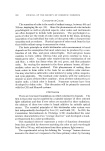
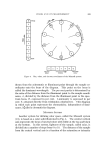
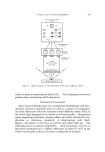
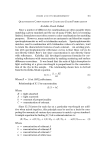
QUANTITATIVE STUDY OF DEPILATORIES UPON IIAIR 703 (a) Comparisons are made within a given hair type. Caucasian should be compared to caucasian, negroid to negroid, and orieutal to oriental. This is done since the ellipsoidal cross-sectional characteristics of hair vary with hair type (e.g., oriental being much more circular than caucasian). Diameters will have meaning only if observed in some con- sistent manner in terms of the reference type chosen. (b) Only sections of hair of fairly uniform width, in which the tapering effect is minimal, are utilized for the determination of T•/and If these two precautions are taken, the normalization process then consists of dividing Td and T• by the mean diameter of the hair, as aver- aged from two points at its extremes. For convenience of measurement, the diameter of the major axis is utilized. The resulting normalized quantities are denoted by To and T•. In hair with a marked difference between major and nilnor axes, the degree of swelling of the minor axis is appreciably greater than that of the major axis on completion of swelling, the cross-sectional area will in- variably be more circular. The authors were concerned that the hair, while swelling in diameter, might at the same time also be uncoiling longitudinally. This would create two problems: (a) Longitudinal swelling would mean that the point on the hair shaft, whose diameter was determined at one position of the traveling microscope, would no longer be at that position when the next determi- nation was made. This, however, did not prove to be a serious source o[ error. From Fig. 2 it may be seen that most of the cross-sectional swell- ing is complete before appreciable longitudinal swelling sets in. (b) The possible twisting of hair on longitudinal swelling could create apparent changes in diameter merely by reorienting the axis being measured. The following two experiments were devised to deternfine whether this twisting did in fact exist: A thin steel wire in the form of a pointer was cemented perpendicular to the long axis and at the lower portion of the hair. A reference point was marked on the outside of the test tube. The position of the pointer, after swelling, was noted and found unchanged. The second, more sensitive, experiment utilized a small mirror ce- mented to the hair in the manner of the pointer in the first determination. This created, in effect, a configuration similar to that found in ballistic galvanometers, where a light beam is utilized to create a long pointer
Purchased for the exclusive use of nofirst nolast (unknown)
From: SCC Media Library & Resource Center (library.scconline.org)