650 JOURNAL OF THE SOCIETY OF COSMETIC CHEMISTS CONCEPTS OF COLOR The sensation of color is the result of radiant energy, between 400 and 700 mu, impinging the eye (10). Since the phenomenon of color includes psychological as well as physical aspects, color scales and instruments are often designed to include both parameters. The psychological as- pects of color are the result of color codes stored in the brain, including association of an individual hue such as blue-green with a characteristic sensation such as coolness. Physical aspects of color result from the fact that visible radiant energy is necessary for vision. The basic principle on which tristimulus color measurement is based depends on the assumption that most colors may be produced by a com- bination of red, blue, and green colored lights. Red and green beams combine to form yellow, whereas blue and green combine to form a bluish-green color. A purple color results from the combination of red and blue a white hue forms when the red, green, and blue primaries unite. By varying the amounts in the three primary beams, all inter- mediate colors can be produced. This phenomenon of uniting three basic colors to form white is the basis for an additive color mixture. One may also form a subtractive color mixture by using yellow, magenta, and cyan pigments. The resultant color darkens with the subtractive mixture as more of these filters combine when all three subtractive pri- maries unite, a black color is formed. Numerous systems have been developed to define color. This discussion will be primarily concerned with the CIE and Munsell systems. CIE SYSTEM There are two basic foundations on which colorimetry depends. The first is that color can be matched by a suitable mixture of three selected light radiations and that if two colors are matched by three radiations, the mixture of these two colors is found additive by suitable optical means. The essential principles of this tristimulus color system were first independently developed by Ives (ll) and Guild (12). In 1931, the Commission Internationale de l'Eclairge (CIE) standardized the color mixture characteristics of an "average observer" and developed a stand- ard framework for a color specification. This standard observer represents a series of functions determined from data provided by observers matching the color at each wavelength from 400 to 700 m•, with mixtures from three primary light sources. The experimental set-up for defining the "average" human observer measures the observer's response to the three primary colors by focusing

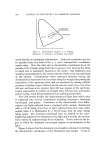
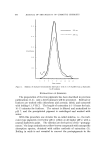
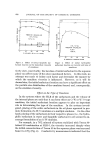
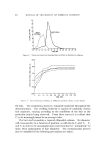
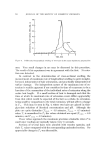
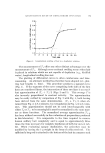
COLOR AND ITS MEASUREMENT 651 1.6 • 1.2 0 400 500 600 700 • m•u Figure 1. Response of the "standard CIE observer" to an equal energy light source SPECTRUM COLORS • GREEN• 'x 540 søø • • RED I BLUE • [ 4•o •.'c' •• ,oo 400 Figure 2. Chromaticity diagram illustrating the visible spectrum locus measured with 10 spectrophotometric readings. The tristimu- lus chromaticity coordinates (x,y) for illumi- nant C are plotted near the center of the chart the three lights on a screen in the same location so that they may be mixed in proper proportions. A monochromatic light source is focused on a spot just adjacent to the mixture of the three colored lights. The observer views the screen through a cone angle of two degrees and is asked to adjust the three primary colors until the mixture matches the mono- chromatic light source, recording the relative amounts of the three lights necessary for the match. Figure 1 shows these relative amounts of red, green, and blue lights between 400 and 700 mu needed by the observer for the match. The monochromatic light is ideally a "white light," meaning that it is an equal energy source containing light from all visible wavelengths. Most standard light sources do contain light of every color, but not in equal amounts. Illuminant A, found in standard in- candescent or tungsten light sources, has light at all wavelengths, with much more energy at longer wavelengths. Illuminant B is a light source equivalent to the noon sun. Illuminant C, representing daylight on the north side of a building, contains light of all wavelengths with much more energy in the blue part of the spectrum. Figure 2 shows the three dimensions of the CIE color solid in two dimensions using x and y chro- marlcity coordinates. These chromaticity coordinates are calculated by expressing the tristimulus values X, Y, Z, as fractions of their total These tristimulus values of a sample are either calculated from diffuse reflectance measurements (9) to be discussed later or they may be mea-
Purchased for the exclusive use of nofirst nolast (unknown)
From: SCC Media Library & Resource Center (library.scconline.org)