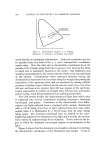
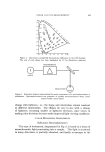
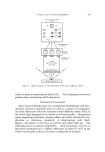
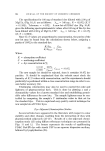
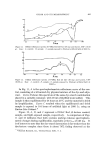
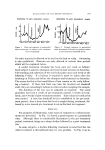
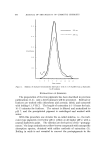
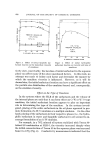
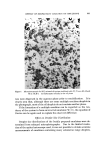
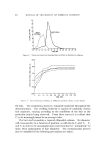
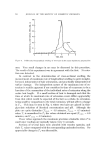
IRON PIGMENTS OF HAIR AND FEATHERS 677 siderins mere incubation of the acid protopigments of red feathers a 40øC effects the change to the red indicator pigment. Until now, little work has been done with the large-sized protopigments. The primary aim was to isolate the so-called chromophore, i.e., the smallest indicator-type unit with the typical absorption bands of the siderins. ISOL^T•OS OF rUE CHROMOPHORE The siderins have two types of groupings: an estimated 98% of their weight is an iron-poor (0.1-0.3% Fe) brown protein with a non- specific absorption spectrum (this component usually precipitates in acids) and about 2% of a relatively small, highly colored, indicator-like, nonprotein chromophore with an isoelectric point at about pH 4.3. The iron is firmly attached to the pigment. This composition is schemati- cally represented below: (Chromophore) Fe TM .... Protein In order to obtain the chromophore, the protein must be removed. This aim is achieved in several steps. First, KSCN (2% final concentra- tion) is added to acid solutions of siderins. Enough protein is precipi- tated by these procedures to render the chromophore combinations in the supernates dialyzable. The dialyzed product passes as a single band through a Septadex G-S0 column. Its two absorption bands in the visible and ultraviolet part of the spectra are in the same fractions (Fig. 1). The dialyzed pigment or the pigment obtained from siderins after splitting with KSCN splits in two fractions when passed through a Septadex G-25 column in 0.1 N NaOH: a more rapidly moving (hence larger molecular weight) broad brown band and a slowly moving narrow orange band which contains the chromophore. Repeated passage through Sephadex G-25 columns yields relatively pure, protein-free chromophores. A chromophore of high purity may also be obtained by precipitating at pH 4.3 the supernatant of the original siderin extract and then eluting this precipitate in a Septadex G-25 column with 0.1 N NaOH. It passes as a narrow orange band after the brown component. PROPERTIES OF THE PIGMENT COMPONENTS The protein part is a brown amorphous precipitate. Its amino acid composition revealed a low cystinc content (mostly traces), indicating

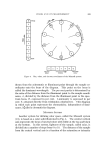
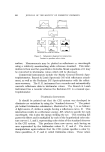
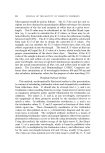
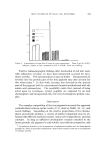
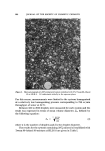
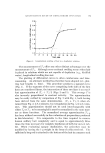
678 JOURNAL OF THE SOCIETY OF COSMETIC CHEMISTS little contamination by keratin decomposition products. With pro- gressing purification, both cystinc and methionine disappear from the protein. The various derivatives (protopigments, siderins, those de- rived by precipitation with KSCN and after dialysis) are remarkably similar in composition, indicating progress toward homogeneity. Their minimum molecular weight was estimated between 6800 and 8300. With increasing purification, as the brown protein is removed, the chromophore assumes increasingly brilliant colors: purple red in acids, orange in alkalies. The compound retains its colors at all pH's, even in strong acids. One of the split products of the siderins with a large proportion of chromophore occasionally turns pink when standing in air in a 0.1 _/V NaOH solution. This color change is reminiscent of similar behavior of two other nonheme iron proteins, transferrin and conalbumin. As in their case, the color change could be attributed to absorption of CO•. from the air by the alkaline solutions and subsequent combination of the iron compound with the chelating bicarbonate ion. This reaction can be pre- vented in vacuo and promoted in a CO•. atmosphere or by the direct addi- tion of sodium bicarbonate to the alkaline solution of this pigment derivative. Upon acidification of the pink product CO• is released realkalinization turns the color to its usual orange shade without restor- ing the pink shade. The chemistry of this type of reaction has been ex- tensively studied both in transferrin (6) and conalbumin (7). THE POSTULATED ROLE OF TYROSINASE IN THE SYNTHESIS OF NONBLACK PIGMENTS It has been claimed that tyrosinase is required for the formation of all "mdanins," black, yellow, or red (5). This assumption is chiefly based on two types of experiments: the dopa-positivity of red hair follicles and autoradiographic studies with labelled tyrosine. Neither can be re- garded as definite proof for the role of tyrosinase in the synthesis of the iron pigment of human red hair. The dopa-positivity of red hair follicles could result from a non- specific catalytic effect of the iron pigment on the autoxidation of dopa. When dopa is incubated in vitro with traces of the iron pigments, its darkening in air is greatly enhanced. The objection that the siderins used in these studies are derivatives of the original pigments is minimized by the fact that traces of ferric ions in themselves have a similar effect (Fig. 2).
Purchased for the exclusive use of nofirst nolast (unknown)
From: SCC Media Library & Resource Center (library.scconline.org)