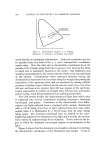
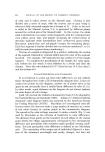
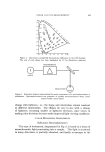
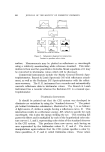
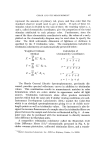
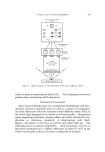
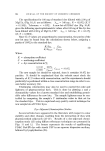
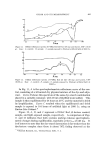
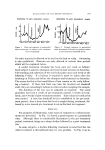
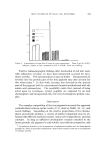
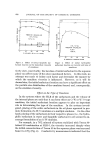
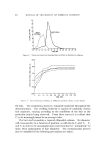
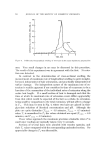
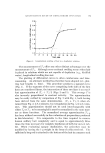
QUANTITATIVE STUDY OF DEPILATORIES UI'ON IiAiR 2.6 2.4 2.2- 2.0- 1.8- 1.6- 1.2 0 4 6 8 I0 12 14 16 18 20 TI ME, MIN. Figure 5. Longitudinal swelling of hair in a depilatory si)lution The measurement of T•. offers one other distinct advantage over the measurement of TD. Although cross-sectional swelling occurs when hair is placed in solutions which are not capable of depilation (e.g., distilled water), longitudinal swelling does not. The plotting of differential curves is often cumberso•ne and time- consuming. An alternate method has therefore been adopted (viz., plot- ting hair lengths vs. time). This procedure produces a sigmoid curve (Fig. 5). If the segments of the curve comprising both sides of the first knee are considered linear, the intersection of these two lines is an excel- lent approximation of (T• q- T•)/2 (Figs. 2 and 5). This average •' is also inversely proportional to reactant activity. The approximation may be easily verified by comparison of Fig. 2 with Fig. ,5, both having been derived from the same determination. (T,• q- T•)/2, when ob- tained from Fig. 2, is 8.5 minutes by extrapolation in Fig. 5, it is 8.,5 min- utes. This approximation should not be used interchangeably with either Ta or T• to be meaningful it must be normalized in the same nmn- her as those functions. The normalized average approximation J'•./o has been utilized successfully in the evaluation of preparations produced in this laboratory. It is comparable to the time required to remove human axillary hair completely and is equal to approximately three times the time necessary for complete depilation of belly fur on test rab- bit. When evaluating opaque depilatories, the procedure may be modified by having the 1-g weight in the form of a thin steel rod. The sufficiently long rod is attached to the bottom of the hair in a manlmr such

7O6 JOURNAL OF THE SOCIETY OF COSMETIC CHEMISTS that it will hang parallel to it and also extend above the solution. The depth of the rod in the solution may then be monitored either optically or through use of a linear voltage differential transformer. CONCLUSION T,, Tf,, and T•,/z• may all be correlated with depilatory efficacy. However, Tj,/D was found to be the most convenient. Evaluation of nearly 500 depilatory preparations has shown this method to be reproducible to a high degree of precision and essentially independent of the physical condition of the hair under test. The sim- plicity of procedure and paucity of necessary equipment make it ideally suited for t he rapid evaluation of formulation modifications. (Received November 20, 1967) (•0) (1l) (12) REFERENCES (1) The Papyrus Ebers, trans. by B. Ebbell, Vol. 63, Copenhagen and London, 1937, p. 76 Ibid., Vol. 67, p. 80. (2) Hiss, A. E., and Elbert, A. E., New Standard Formulary, G. P. Engelhard, Chicago, 1910, p. 1001. (3) Weinhold, P.M., Brit. Patent 478,176 (1938). (4) Lucas, II. V., U.S. Patent 2,067,909 (1937). (5) Gemsback, H., U.S. Patent 1,620,$39 (1927). (6) Perl, J., U. S. Patent 450,032 (1891). (7) Evans, R. L., and McDonough, E.G., U.S. Patent 2,3•2,•24 (1944). (8) Alexander, P., Review of progress in cosmetics, Specialties, 16• $ (1965). (9) Walker, G. T., The chemistry and formulation of depilatories, Am. Perfumer Cosmetics, 77, 86 (1962). Schimmel Britfs, Cosmetic formulations from the patent literature, H340 (July 1963)., Rousell Labs Ltd., Calcium thioglyeollate as dipilating agent, Soap, Perfumery Cosmetics, 31, 799 (1955). Bull, K. B., Chemical depilatories, Ibid., 31• 63 (1965).
Purchased for the exclusive use of nofirst nolast (unknown)
From: SCC Media Library & Resource Center (library.scconline.org)