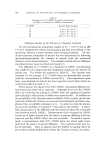
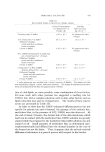
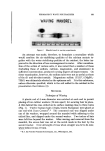
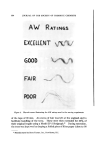
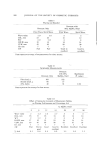
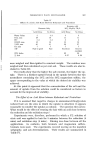
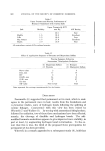
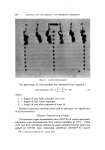
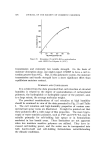
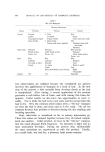
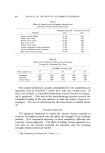
PERMANENT WAVE NEUTRALIZER Table IV Effects of a Citric Acid Rinse Between Reductant and Neutralizer 857 Bromate Only Bromate with 36% MgSO4.7H•.O Acid Rinse No Rinse Acid Rinse No Rinse Water Value 2 2.3 3 3 D2L, mm 18 16 12 12 WT 2.3 2.3 3 3 D2LW, mm 15 16 13 13 VLW, mm 40 41 38 37 ID, mm 7 7 7 7 AW Fair to good Fair Excellent Good to excellent 20% Index ...... 60 55 % Ash ...... 0.37 0.56 were weighed and then ignited to constant weight. The residues were weighed and then calculated as per cent ash. These results are also in- cluded in Table III. The results show that the higher the salt content, the higher the up- take. There is a distinct upward break in the uptake between the two neutralizers containing the 24% and the 36% magnesium sulfate, the upper corresponding to the value at which the desired air stability was achieved. At this point it appeared that the concentration of the salt and the amount of uptake from the solution could be considered as factors to account for the improved air stability. The Effect of an A cid Rinse between Reductant and Neutralizer If it is assumed that negative charges in ammoniacal-thioglycolate reduced hair are the sites to which the uptake is attached, it appears reasonable to consider the uptake as cationic. The question then arises: What would be the effect of treating the hair with an acid rinse between the reduction and the oxidation steps ? Experiments were, therefore, performed in which a 3% solution of citric acid was applied to hair for 8 minutes between the reduction (6 mins) and oxidation step (8 mins). Rinsing was done between all the applications. As oxidants, both bromate and magnesium sulfate- bromate were used. The experiments covered waving on the mandrel, serigraphy, and ash determinations. Their results are summarized in Table IV.

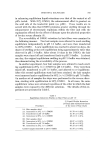
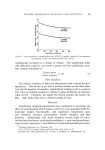
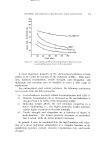
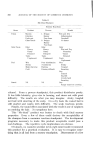
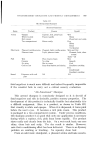
858 JOURNAL OF THE SOCIETY OF COSMETIC CHEMISTS The results obtained in these experiments indicate that: 1. The acid rinse lessened the cation uptake by 34%. In addition, the network-like ash characteristic of the salt-bromate neutralizer was not at all evident only a small clumplike residue was visible. 2. The waving performance on the mandrel, despite the lessened uptake, was somewhat improved. The general range of values was not much changed without added salt, the AW values re- mained in the fair range with salt, close to excellent. The im- provement was manifest in a greater degree of regularity. 3. Serigraphically, there is no loss of strength. 4. Although the in-between acid rinse improved the waving sequence when no salt was added to the neutralizer, this three-stage waving sequence cannot be said to approach the over-all performance of reductant followed by bromate-containing magnesium sulfate. Citric acid could be expected to include, among the possible actions, that of neutralization of the excess negative charges in the keratin. The fact that the acid displaced a significant portion of the cationic uptake permits the conclusions to be drawn that: 1. Part of the mechanism of action of the added magnesium sulfate is one of charge neutralization and 2. Uptake does strongly parallel improvement in waving per- formance, but it is not a sole operating mechanism. Dehydration Mechanisms and Itydrogen Bond Re-formation The question arises: What other mechanism(s) could be involved? The consistent improvement in waving properties throughout a wide range of increasing salt concentration suggested a possible dehydration mechanism. Two possible dehydration mechanisms were considered: one osmotic and the other a salt-protein interaction in which the water that is hydrating the protein is removed by a salt in sufficient concentration. In order to determine whether an osmotic mechanism is operating, the vapor pressures were determined of a series of neutralizers in which a number of salts in varying molalities were combincd with sodium bromate whose final concentration was 0.67m. Tresses were then waved utilizing these neutralizers. The effects of the added salt on the AW values are shown in Table V. In utilizing this approach, the assumption was made that if the effect of the salt were due only to the solution properties (as osmotic pressure)
Purchased for the exclusive use of nofirst nolast (unknown)
From: SCC Media Library & Resource Center (library.scconline.org)