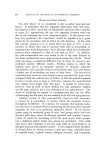
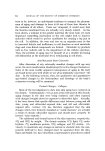
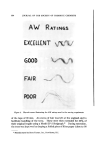
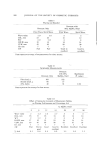
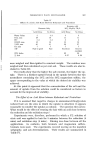
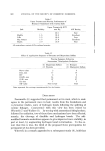
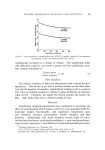
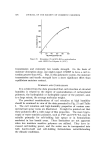
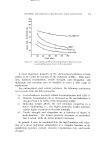
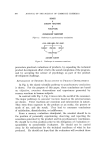
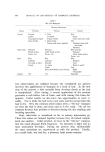
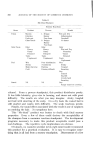
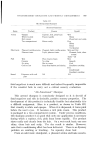
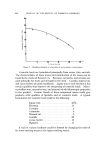
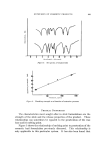
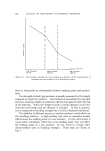
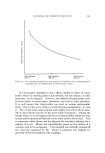
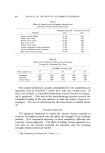
PERMANENT WAVE NEUTRALIZER 85,0 and not to specific salt-protein interaction, then the determination of vapor pressure lowering should correlate with the effect on curl forma- tion. In Table V the results of the measurements of vapor pressure lowering indicated that this property could not be used to predict the effect of a salt on air stability there was no indication that a given vapor pressure range or a required vapor pressure lowering could be cited as required for optimum waving results. The experimental results to this point may be interpreted as follows: The magnesium sulfate in relatively low concentration neutralizes the ex- cess negative charges and brings the keratin closer to its isoelectric point here, the protein is most easily susceptible to dehydration which is then effected by the salt's relatively higher concentration (4). During de- hydration, the hydrogen bonds whose strength and tendency to form are minimal in water itself, have, in the relatively decreased water content (provided by the high concentration of the added salt) an increased like- lihood to re-form (5). Consecutive or Simultaneous Application of the Added Salt with the Oxidant The favorable results of adding a salt in sufficient concentration to the oxidant raises the question of how the effectiveness of the salt would be influenced by its being applied separately to the hair just prior to or fol- lowing the oxidant. To answer this, tresses were waved by first reducing them for six minutes with ammonium thioglycolate these were then divided into two groups which were treated by either of the two following procedures: 1. 30% aqueous solution of magnesium sulfate followed by a bromate neutralizer, each for 8 minutes or 2. A bromate neutralizer followed by a 30% aqueous solution of magnesium sulfate, each for 8 minutes. Rinsing was done after application of each of the above solutions. The experimental results are summarized in Table VI. From the tabulated results, it is evident that the tresses in the two groups somewhat resemble one another and that both are quite similar to tresses waved with the salt-free bromate neutralizer. This is especially noticeable in their rather poor AW values. These results clearly indicate that for the added salt to be of benefit in conferring air stability on the tress, it must be applied simultaneously with the oxidant. Apparently, the re-formation of the secondary bonds is facilitated only if done at the same time as those of the disulfide bridges.

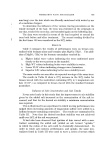
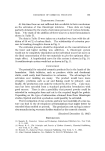
860 JOURNAL OF THE SOCIETY OF COSMETIC CHEMISTS Table V Vapor Pressure and Waving Performance of Bromate Neutralizers with Various Salts Vapor Pressure • 30øC Salt Molality mm Hg AW Rating ...... 30.1 Fair MgSO4 1.5 29.3 Excellent LiBr 1.5 29.0 Poor Mg Acetate 1.5 27.8 Excellent MgC12 2.0 25.0 Fair All neutralizers contain 0.67m sodium bromate. Table VI Effect of Application Sequence of Bromate and Magnesium Sulfate Waving Sequence Following Ammonium Thioglycolate Reduction (1) Magnesium Sulfate (2) Bromate (1) Bromate (2) Magnesium Sulfate Wave value 2 3 D2L, mm 17 14 WT 3 3 D2LW, mm 14 12 VLW, mm 37 37 ID, mm 7 7 AW value Poor to fair Poor Data represent the average measurements for six tresses. DISCUSSION Farnworth (6) suggested that permanent set in wool, which is anal- ogous to the permanent wave in hair, results from the breakdown and re-formation (italics, ours) of hydrogen bonds following the splitting of cystinc linkages. Concurrence with this view has been voiced by Whewell (7) and Walker (8). In waving with ammoniaeal thioglyeolate, followed by oxidation, two of these three mechanisms have been effected, namely, the cleavage of disulfide and hydrogen bonds. The salt- modified bromate neutralizer appears to give improved wave stability, in part at least, by augmenting hydrogen bond re-formation. To the ex- tent that this is true, the third of the proposed three prerequisites for permanent set has been provided. Whewell. in a remark appended to a subsequent study (9), held that
Purchased for the exclusive use of nofirst nolast (unknown)
From: SCC Media Library & Resource Center (library.scconline.org)