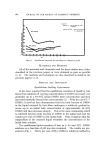
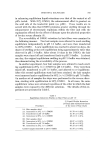
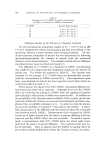
PERMANENT WAVE NEUTRALIZER 861 the role of hydrogen bond breakers was complex, but they did seem to increase disulfide scission by bisulfites. He described the action of di- sulfide breakers as that of a key which opens up the fiber so that hydro- gen bond breakers can be effective. The effectiveness of the modified neutralizer makes the reverse reasoning of the previous statement inter- esting to consider: namely, that the re-formation of hydrogen bonds seems to increase disulfide relinkage and that the substances that restore disulfide linkages act like a key which closes up the fiber so that hydrogen bond re-formers can be effective. It is our observation that the re- formation of both types of bonds must be done concomitantly for the pro- duction of the optimum wave stability. The simultaneous relinkage of both types of bonds has been given the term of "parallel waving." Bogaty showed by carefully chosen experiments (10) that the individ- ual participation of both primary and secondary bonds in the waving procedure could be demonstrated, and, furthermore, that the potential benefits to waving by an effective utilization of secondary bonds (along with sulfur cross links) was yet to be fully realized. Hopefully, this study demonstrates a manner by which this can be accomplished. SUMMARY Tresses were set with a bromate-based neutralizer modified by the addition of an amount of magnesium sulfate in excess of 24%. Com- pared to the results obtained with the unmodified bromate neutralizer, the tresses were superior in air- and water-stability did not lose their improved performance despite repeated waving and gave appreciably higher 20% index values when determined on the serigraph. A study of this neutralizer's possible mechanisms of action indicates that a combination of effects appears responsible for its beneficial action. Among these are: charge neutralization, uptake of the added salt, and re-formation of hydrogen bonds. To be effective, the added salt must Be applied concomitantly with the oxidant, thus re-forming both disulfide and secondary bonds at the same time, a process labeled "parallel wav- ing." AC•SOWI. EDCMEST The valuable suggestions and technical assistance of Dr. T. W. Gilbert are gratefully acknowledged. The authors also thank Mr. John Solaro for considerable technical aid and assistance. (Received December 8, 1967)

862 JOURNAL OF THE SOCIETY OF COSMETIC CHEMISTS (1) (2) (3) (4) (5) (6) (7) (8) (9) (10) REFERENCES Gershon, S. D., et al., J•ermanent Waving, in Sagarin, E., Cosmetics: Science and Tech- nology, Interscience Publishers, New York, N.Y., 1957, pp. 593-4, 599. Alexander, P., and Hudson, R. F., Wool: Its Chemistry and 1Physics, Reinhold Pub- lishing Corp., New York, N.Y., 1954, pp. 62-3. Reiss, C. R., and Lichtin, J. L., U.S. 1Patent3,266,994 (August 16, 1966). Weiser, H. B., Colloid Chemistry, John Wiley & Sons, Inc., New York, N.Y., 1949, pp. 299-300,305. Klotz, I. M., and Franzen, J. S., Hydrogen bonds between model peptide groups in solution, J. Am. Chem. Soc., 84, 3461-6 (1962). Farnworth, A. J., The hydrogen bonding mechanism for the permanent setting of wool fibers, Textile Res. J., 27,632-40 (1957). Whewell, C. S., The chemistry of hair, J. Soc. Cosmetic Chemists, 12,207-23 (1961). Walker, G. T., Permanent waving theory, Drug Cosmetic Ind., 90, 692 (1962). Whewell, C. S., The chemistry of hair, J. Soc. Cosmetic Chemists, 15,423-36 (1964). Bogaty, H., Molecular forces in permanent waving, Ibid., 11,333-42 (1960).
Purchased for the exclusive use of nofirst nolast (unknown)
From: SCC Media Library & Resource Center (library.scconline.org)