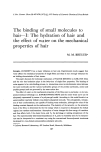
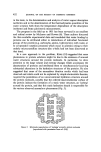
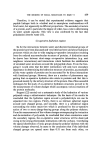
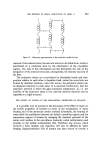
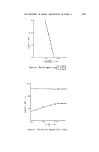
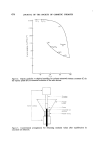
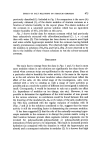
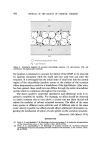
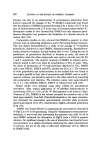
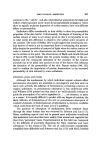
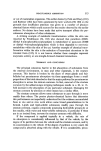
456 JOURNAL OF THE SOCIETY OF COSMETIC CHEMISTS supported by results of dielectric measurements which have shown that in proteins about 70•o of hydration water has very limited freedom of move- ment (17), and by results of recent measurements which indicate that water adsorbed on oriented polypeptide films exhibits dichroism of its funda- mental ir frequency suggesting a strong binding of the water to discrete sites which bind water in an oriented way (18, 19). A considerable amount of work has been carried out on the interaction of water with carboxylic, amino and peptide groups attached to small molecules. The results of these investigations are in good agreement and support the results obtained on polypeptides [for a review of this work see the discussion in (15)]. An important question which also requires consideration is whether or not the macromolecular conformation of the polypeptide chains has any influence on the water binding properties of the proteins or polyamides. The detailed work of Puffr and Sebenda (20) on the water adsorption properties of polyamides (Nylon 6 and 66) is highly important in this context. Puffr and Sebenda classified nylon structures into crystalline regions, mesomorphic areas and completely amorphous regions. In a series of detailed studies they measured water binding curves of polyamides containing different proportions of these three regions, and found that the degree of crystallinity, determined by ir and density measurements, in- fluences the water uptake of nylon. Puffr and Sebenda constructed a plot of water adsorption capacity of nylons as a function of the degree of crystallinity. They found by extrapolation that completely crystalline nylon does not adsorb water at all, whereas entirely amorphous polyamides bind 1.5 moles of water per peptide bond (Fig. 7). As an explanation it was c• o Figure 7. Plot of amount of water absorbed by Nylon 66 as a function of O, the degree of crystallinity [reproduced with permission from ref. (20)].

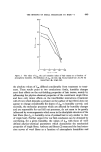
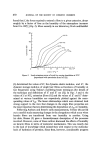
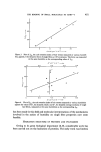
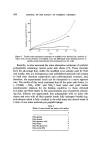
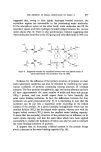
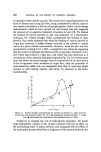
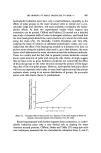
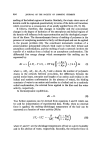
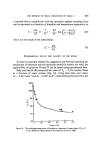
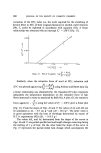
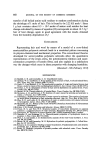
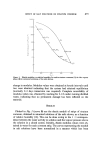
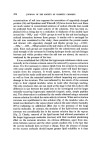
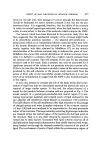
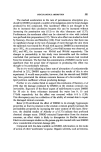
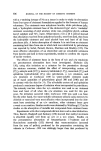
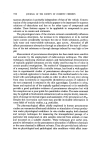
THE BINDING OF SMALL MOLECULES TO HAIR--I 457 suggested that, owing to their tightly hydrogen bonded structure, the crystalline regions are inaccessible to the penetrating water molecules. In the amorphous nylon on the other hand, water molecules can fill the interchain spaces and form hydrogen bonded bridges between the various nylon chains (Fig. 8). There is also spectroscopic evidence suggesting that water molecules bond first to the CO group and only afterwards to NH (21). %0 ...... .... .... " CO .... HN..,. '"'HN•.• 0 .... HN) S / Figure 8. Suggested formulae for complexes between water and peptide bonds of nylon [reproduced with permission from ref. (20)]. Evidence for the influence of the tertiary structure of proteins on their water adsorption isotherms can also be obtained by examining the water vapour isotherms of proteins containing varying amounts of e-helical contents. The four proteins lactoglobulin, egg- and serum-albumin and zein all have approximately the same number of acidic and basic side groups 100g 4 protein, and one would expect them to have basically the same water binding isotherms. In fact, the differences between the four isotherms are quite pronounced (Fig. 9). It is interesting to note that the isotherms can be put into a sequential order according to the helical content of the protein. At a given humidity lactoglobulin which has the smallest helicity (10•o) has the largest water uptake, whereas zein with the largest helical content (70•o) shows the smallest water binding capacity. It seems that the secondary structure of the protein has an influence on its water uptake capacity, and that the same ideas which have been applied successfully to explain the hydration of nylon can also be used to interpret the water binding isotherms of proteins. It appears that an increasing e-helical content in the protein brings about a decrease in the water binding capacity (Fig. 10).
Purchased for the exclusive use of nofirst nolast (unknown)
From: SCC Media Library & Resource Center (library.scconline.org)